Showing posts with label sheep. Show all posts

Monday, 23 May 2011

Mutton dressed as mutton - because why would you dress it as anything else?


Mutton has had a couple of mentions on this blog before, but only in reviews of meals eaten out, and although I’ve long meant to do some at home I’d never quite got round to it, until last weekend.  Which is something of a fashion faux pas on my behalf, because mutton is currently so achingly hip that you are much more likely, these days, to come across lamb dressed as mutton than the other way around.  Except perhaps in your neighbourhood curry house, although even there, if it’s half way decent, I’d assume that when they say lamb they mean lamb, and when they mean mutton they say ‘meat’.  And generally of course mutton would be not only more ‘authentic’ (don’t worry, I’m not going off on that topic today…) but entirely more appropriate than lamb for most ‘Indian’* cooking, far better suited to the heavy spicing and long slow cooking that would normally entail.

Anyway, we were 6 for dinner, on a Sunday, so it seemed a perfect opportunity to roast a leg of mutton and get on board with the ‘mutton renaissance’ (and just because Prince Charles supports a thing it doesn’t automatically mean it’s a bad idea – although I can’t help but fear it must cast some doubt on my own earlier claim of trendiness.  There again, taking into account the sheer quantity of tweed being worn by Dalston hipsters these days, maybe I’m the one out of step here, and Charlie boy’s bang on trend).

1 leg of mutton (2.5kg)

2 big fat salted anchovies (and their salt)
2 big fat garlic cloves
1 inch of fresh red chilli
A dessert spoon of capers
Plenty of black pepper
Plenty of olive oil
1 stalk of rosemary, a handful of thyme leaves


On Saturday evening, I pounded the ingredients for the marinade – apart from the herbs - into a paste with pestle and mortar and rubbed that paste into the lightly scored surface of the joint, along with the rosemary and thyme leaves. Then I put the leg back into the bag it came home from the butchers in and returned it to the fridge overnight.

On Sunday afternoon I took the leg out of the fridge in plenty of time to get up to room temperature before starting to cook it. Then I preheated the oven to about 250 - with the roasting tray inside to get hot enough that when the leg was placed in it you heard it sizzling furiously - and then I turned it down to 230 when the meat went in, left it for 30 minutes, then turned it down again, to 150 for another hour.  Then I took the joint out and let it rest for a good 30-40 minutes before carving, more into thick chunks than slices.


I made a simple gravy by just deglazing the roasting tray with sherry (about 150ml), and a punchy mint sauce by roughly chopping a good bunch of mint leaves then pounding them together (pestle and mortar again) with a couple of garlic cloves, a sprinkling of dried chilli flakes, flaky sea salt, pepper, a good slug of extra virgin olive oil until I had a good thick paste, then thinned that out with sherry vinegar – about an espresso cup’s worth (which is what I served it in).

Served up with the gravy, the sauce, some home made medlar jelly and sides of roasted Jersey Royals and asparagus, and wilted spring greens, this was arguably the best Sunday roast I’ve ever done (I couldn’t possibly be conceited enough to suggest ever had – could I?).  Much richer and more densely flavoured than lamb, and certainly no less tender, despite commonly held pre/misconceptions.  And fond as I am of roast beef - and I am very fond of roast beef - I would suggest that mutton is more interestingly flavoured, with just a hint of gaminess.
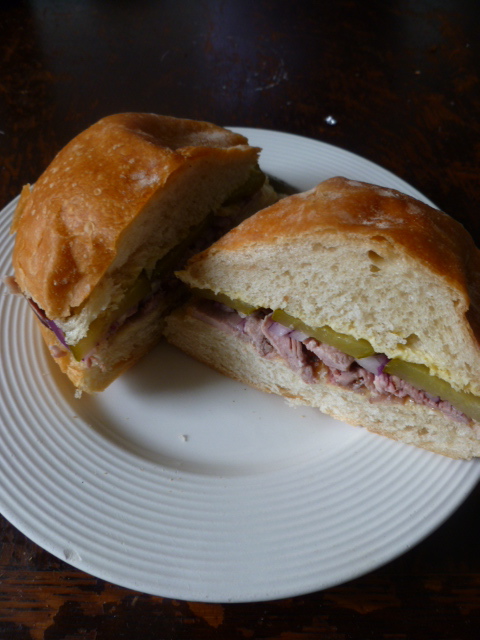


Also, like beef, but unlike lamb, it was just as good cold, and made wonderful sandwiches over the following couple of days, with a layer of that medlar jelly, a good smear of mustard, some finely sliced rings of red onion, and cucumber (pickled for me, fresh for Becca).


And that’s not to mention the shepherds pie, made with diced meat and some of the delicious stock made from the bone.  Or the spicy mutton, chorizo and butter bean stew that Becca had waiting for me one evening on my return from work.


It was also, it has to be said, something of a bargain - markedly cheaper than lamb or beef would have been - with the whole 2.5 kg coming in at under twenty quid from those fine chaps at Theobalds.  And from that we not only had our dinner party for six, but as you see from the above, pretty much fed ourselves for the rest of the week.


* Here I am using ‘Indian’ as a catch all term for what might perhaps most accurately be described as British curry house cuisine – except that sounds inescapably derisive.  I am fully aware of the fact that as many if not more of those curry houses might be Bangladeshi or Pakistani, and that there are many great and distinct cuisines of the South Asian sub continent – Bengali, Punjabi, Keralan etc – and that more and more restaurants these days are devoting themselves to, and advertising themselves as, serving up purer, more authentic expressions of those cuisines, and a very good thing too.  I can, though, easily imagine a future in which ‘authenticity’ is claimed for indigenous British Asian cooking, and restaurants serving lipstick crimson tandoori chicken, and hi-viz orange tikka masala become ragingly fashionable.


Tuesday, 1 March 2011

Love is… lamb’s hearts, pigeon breasts and oysters


Becca and I were away for the 14th of February, with family and family friends, so we postponed Valentine’s day until we could do the whole romantic diner a deux thing at home.  Which, by the way, is where Valentine’s night dinners belong.  At home.  Why anyone ever even considers eating out on the 14th itself is entirely beyond me.  For a start, by the time you get round to it, you have almost certainly left it too late to book a table at any of the restaurants you actually want to eat at, and end up somewhere you otherwise wouldn’t countenance – for what will probably turn out to be very good reasons.  For a finish, even if you do manage to bag a table at that place you’ve always dreamed of eating at but somehow never have, you’ve only gone and done it on the single worst night of the year to eat there.  Not least because it’s the worst night of the year to work there.  Seriously.  Flat out worst.  Why would you want to celebrate your love by paying over the odds for a limited – sorry, ‘special’ – menu, served to you by people who are not only rushed off their feet, but actively hate you.

What do you mean?  Of course they hate you.  Not only are you contributing to their busiest, most thankless night of the year (other nights, round Christmas, say, may be busier than Valentine’s in terms of total covers, but because those covers, on Valentine’s, are all divided into tables of two, the work involved in servicing them is far greater, and at Christmas, season of goodwill to all men including waitresses, the tips are way, way better than the night when everyone is at least pretending to only have eyes, or thoughts, for the person directly across the table from them), but you are simultaneously either keeping them apart from their loved one on this special night, or reminding them that they are single, loveless and alone.  They hate you.  Even if only for that one night.

None of which, of course would have prevented Becca and I eating out on February the 24th, which was when we finally got round to it, but even so.  There are other reasons to keep it at home.  After all, if all goes well, and the romance works its magic, why would you want to be out, in a public place?  A hotel restaurant, maybe, where you could, literally, get a room, but then you are seriously talking about paying for your love.  And while there are those for whom a credit card is, among other things, a sex aid, and the strength of a relationship is measurable by the length of the statement, the rest of us prefer to believe that such people fail to understand the true nature of romance, and will never find true love, let alone live happily ever after.  Which, without wishing to come across as a cheapskate, is another very good reason for keeping it at home.  Keeping the cost down, that is, not running the risk of finding oneself inadvertently a loveless billionaire (which of course you may well want to do, whichever way you are reading the phrase ‘finding oneself”…).

Of course, it’s always cheaper to eat at home than to eat out, particularly on a night you would be paying a premium for the privilege of being hated, but even more so if you and your loved one can find the romance in offal and vermin.  Or lamb’s hearts and pigeon, to be precise.  In which case you can return home from a friendly butchers with the feature items of your special meal, and paper change from a tenner, just about.  (You could, of course try and catch your own pigeon, and then it’d be even cheaper…)

Lamb’s hearts is something of Valentine’s tradition in this house – and a fairly obvious reference to (or parody of, perhaps) romantic symbolism, although one, I have to admit, that only works so long as the object of your affections isn’t too literal minded: ‘So you’re offering me the heart of a cute little baa lamb.  Cut into tiny pieces and flash fried.  As a token of your love.  Yeah, thanks… ‘ Fortunately Becca is neither so literal minded, nor too sentimental about cute little baa lambs.  Or if she is she’s just too damn polite to mention it.  Previously I’ve fried the hearts and served them as a main course salad, but this year that was precisely my plan for the pigeon breasts, so I needed to do something different.  Cooking them up with onions in sherry, seemed right: light and simple but sweet and a little bit luxurious.

Light and simple is a key element in a Valentine’s meal, I think.  You’re not looking for big, heavy, comfort eating, no matter how much you both may like it.  And you don’t want to be doing anything too fiddly or labour intensive.  The last thing you want to be doing is working up a sweat, juggling pans over a hot stove and clock watching while your beloved twiddles their thumbs and gets prematurely, solitarily, hammered on pink fizz.  So a collection of dishes that can be mainly prepared in advance then quickly and easily thrown together at the last minute is what you’re after.  On this occasion I cooked up the lamb’s hearts and onion in sherry, marinated the pigeon breasts, washed and spun dry the salad leaves and peeled, diced and par boiled the potatoes ready for sautéing, all before Becca got home from work.  And laid the table with flowers and candles and all that romantic crap.  So when it came to time to eat I just had to fry up the pigeon breasts and the potatoes, make a dressing for the salad, and throw it all together on the plates while reheating the lamb’s hearts.  The hardest part was shucking the six oysters we had for starters.

Lamb’s hearts and onion in sherry
2 lamb’s hearts
1 small onion
garlic, a little fresh red chilli (optional), a few sage leaves, thyme salt & pepper
A glass or two of sherry.  I used Oloroso, but fino or manzanilla would be fine.  Or marsala, or Madeira for that matter…


First trim the hearts of all their white bits of fat, gristle and membrane, slice them in two longitudinally, then slice each half into pieces cross ways.  Put them in a non metallic dish or bowl, season with salt and pepper, add the sage leaves, a pinch of thyme leaves, cover with sherry and a splash of olive oil, and leave to marinate for an hour or two, if you have the time.  Peel and slice the onion into fine wedges, and finely slice a clove of garlic and just a little bit of fresh red chilli (you want a hint of warmth, not direct chilli heat, by all means leave it out if you prefer).  Remove the lamb’s hearts from the marinade, and fry swiftly in a hot pan until just colouring , then add the onion garlic and chilli, with maybe a little extra olive oil if the pan looks dry.  Cook until the onion is softening, then pour over the remaining marinade, and add an extra splash of sherry if necessary, but you don’t want the pan swimming.  Simmer hard for just a few minutes for the sauce to reduce and thicken just a little.  You don’t want to cook it too long or the hearts will go rubbery (they’re one of those things that need to be cooked either hot and quick, or low and slow).


Pigeon Breast salad
2 pigeons (or just their breasts)
Mixed salad leaves (I had radicchio, for the pretty colour, chicory and rocket)
A glass of red wine
Salt, pepper, thyme leaves, juniper berries
Sherry (or red wine) vinegar and extra virgin olive oil, for the dressing

Remove the breasts from the pigeons, it’s easy with a small sharp knife, although apparently real men do this with their thumbs…  Skin the breasts, put them in a non metallic dish or bowl, season with salt and pepper and a pinch of thyme leaves, pour over the wine and a splash of olive oil, and throw in half a dozen or so juniper berries (gently crush the berries between thumb and forefinger before adding them, to better release their flavour) and leave to marinade for an hour or two.  As with the lamb’s hearts, if you don’t have the time, or the juniper berries, the marinating can be skipped, but it is going to taste better if you can do it.


When you’re ready to eat, put the washed and dried salad leaves in a bowl, remove the pigeon breasts from their marinade and fry in a good hot pan, for no more than a couple of minutes a side - you want them nice and pink.  Remove the pigeon breasts from the pan, but leave it on the heat.  Make the salad dressing with the pan juices, while the pigeon breasts rest.  Deglaze the pan with the leftover marinade and a splash of sherry vinegar, then turn off the heat, and stir in a tablespoon or two’s worth of extra virgin olive oil.  Strain through a sieve or tea strainer, check the seasoning, balance the oil/vinegar and pour over the salad leaves in the bowl.  It’s common with a salad like this to serve the pigeon breasts sliced (as I have done recently with veal goose skirt and feather steak), and perhaps mixed with the salad leaves, but I actually prefer to serve them whole and on the side.  Either way is good, whatever works for you, aesthetically.  I guess if I was serving this as a starter, I’d probably allow just one breast per person, and slice it.

Our starter, for this meal, as I’ve said, was oysters.  Bit of a Valentine’s cliché, I know.  But why not?  Just served up with wedges of lemon, a bottle of Tabasco and an espresso cup of shallot vinegar (except I didn’t have a shallot so I finely diced about 1/8 of a red onion instead, and covered it with sherry vinegar).  Damn I love oysters, and at a fiver for six from our excellent local  (Stoke Newington) fish monger, they’re an affordable luxury I don’t really know why we don’t have more often.

Oh, and I nearly forgot dessert.  Both in writing it up, and in making the meal.  You may have noticed from this blog I’m not really much of a dessert person.  So I’m afraid to say, as something of an afterthought, while I was putting together the rest of the meal, I peeled and thickly sliced a couple of oranges and put them in a bowl to soak in cointreau in the fridge, and made up a couple of very large and very sweet espressos and poured them into a shallow Tupperware container and whacked that into the freezer.  By the time we’d finished the rest of the meal, that had frozen just about sufficiently to make a couple of coffee granitas served up in espresso cups alongside a bowl of cointreau orange.  A sprig of mint on the oranges would have been enough to make it look almost intentional…


Thursday, 20 January 2011

Kleftiko-ish


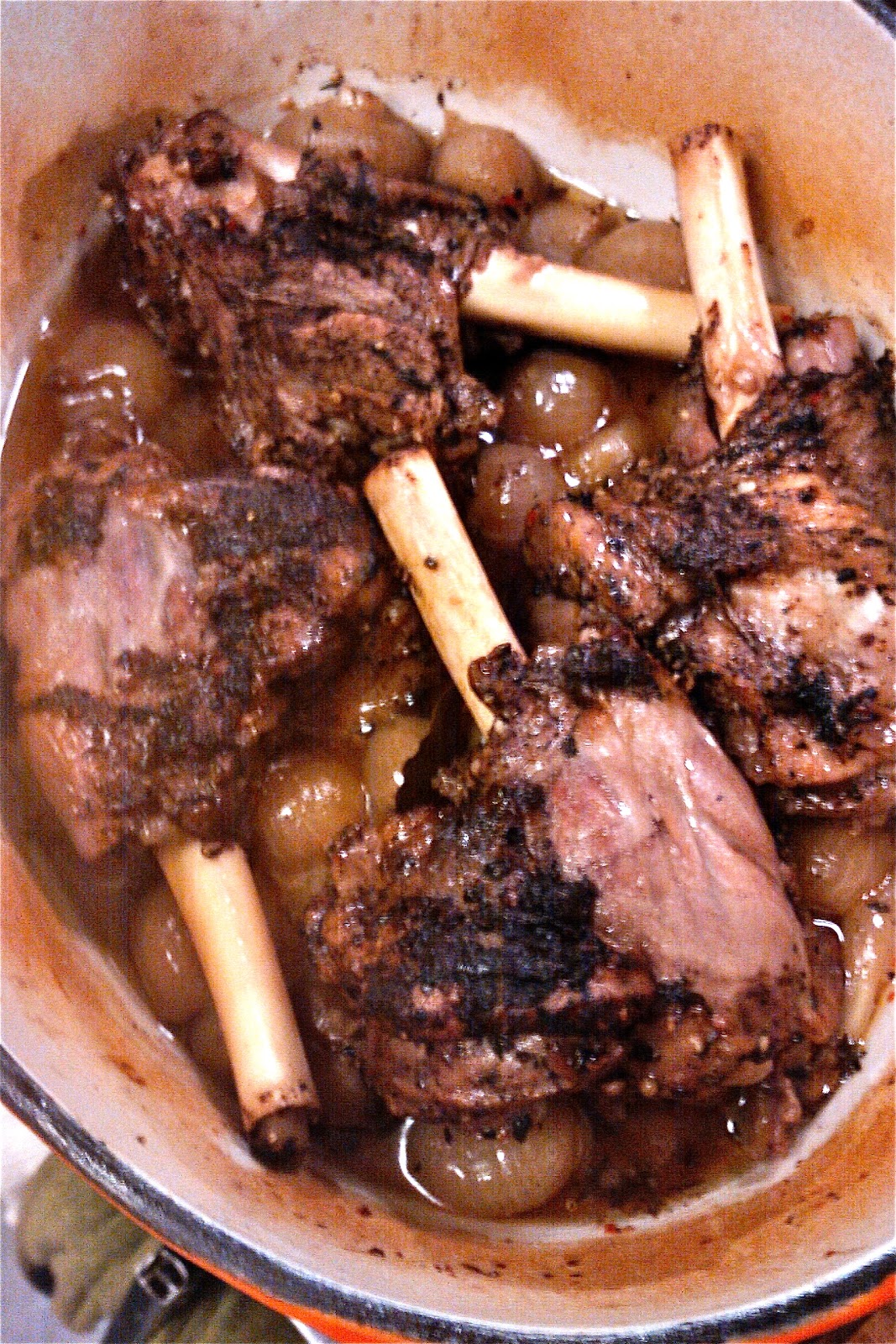
So, as promised, here’s one to upset the Greeks, as I desecrate another great culinary national treasure, or, as I prefer to think of it, take inspiration from another great culinary national treasure.  Yeah I know.  I’m doing it ALL WRONG, and how dare I?  But I don’t care.  I really don’t.   And that’s not because I’m peculiarly dismissive of the sensibilities of the Greek people, or because I’ve got anything against them at all, any more than I have against the French or the Italians (which, I will say again, is NOT AT ALL).  I would say that many of my best friends are Greek, but that would be a lie, although, when I spent a year living in Rome a (long) while back, many of my friends were (the Greek and the Spanish students being the ones who threw the most parties meaning that, as a foreign student in the capital of Italy, the people you most easily got to meet – and to get drunk enough with to lose your inhibitions about conversing in your still shoddy Italian – were mainly Greek and Spanish.  Not so many actual Italians, and pretty much NO Romans, who already had their own social and family circles and therefore neither the need nor the inclination to make friends with a bunch of Brits/Greeks/Spaniards who were constantly babbling at each other in a drunken approximation of the language of Dante.  I digress…).  But I do have half Greek cousins, and I do love Greek food.  The original Real Greek, on Hoxton Market, before it sold out to THE MAN, and became a chain, used to be one of my favourite restaurants, and I think wistfully of their chicken livers, and cured mackerel, to this day.

One thing I never had at the Real Greek, though, was kleftiko.  Mainly because it didn’t feature on the mezedes menu, which is what we would generally be ordering from, but I don’t recall it appearing much, if at all, on the main menu either.  Not really their kind of thing (although owner/founder/chef Theodore Kyriakou has a recipe here, but I have to say he uses a boned joint, and roasts it pretty hot and quick, which seems at least as wrong as anything I’m proposing).  Just my kind of thing though.

Ah, kleftiko.  Lamb slow cooked on the bone till it’s falling off and ready to fall apart in your mouth, densely flavoured with aromatic herbs and spices.  Just thinking about it makes me want to eat it now, and if I do go to a Greek restaurant and see it on the menu, and the thought is put in my head, it’s very hard to order anything else.  The first time I thought about doing it at home, I looked up recipes and, of course, in the way of bolognese, or risotto, or cassoulet, or any classic dish that is essentially peasant food in origin, I came across any number of variations and almost as many mutually incompatible claims of authenticity.  Some cooked the meat dry, some wet, some included onions, carrots and potatoes (or some combination of all or any of the above).  Some included cheese.  Almost all, however, called for the construction of some kind of sealed parcel for cooking the meat in, made from folded layers of parchment paper or foil, which was the point at which they lost me. 

That seemed like a lot of faff.  I have a selection of cast iron casseroles with lids that fit pretty well – as they should, the amount I paid for them (actually, to be fair, mainly other people did.  Most of them were gifts) - wouldn’t they do?  Yes they would.  Whether the result is strictly speaking kleftiko, or just mouth meltingly tender pot roasted lamb is open to debate, all I know for sure is that it tastes good.

You can use lamb shanks for this, as I have in the accompanying photos (allow one per person), or any bone in joint - but I would suggest leg rather than shoulder.  The first, and probably most important, thing to do is marinate the meat well.  Exactly what goes in to the marinade is up to you and what you have available, but I would suggest the essentials are lemon, garlic, olive oil and plenty of fresh oregano, thyme or rosemary (or combination of all or any), plus salt pepper and olive oil.  Personally I would also include fresh chilli, a sprinkling of sumac and maybe star anise (although I might just add one of those to the pot come roasting time), if you wanted to add crushed fennel, cumin or coriander seeds I see absolutely no reason not to.  Put the meat in a non metallic dish, lightly scoring the surface if it has a covering layer of fat or skin, generously salt and pepper it, grate the zest of a lemon or two over it, then add the juice, crush a clove or two of garlic over it (and chilli if you’re using that - when I’m marinading I always roughly chop a clove of garlic and a chilli and crush them together in the garlic crusher, the only time I ever use that device), throw on the herbs (and whatever else you want to add) and a little olive oil.  Give it all a good rubbing in, then cover it and put it in the fridge for at least a few hours, preferably overnight.

Take the marinading meat out of the fridge early enough to return to room temperature before you start cooking, and at least four hours before you want to sit down to eat.  Peel a bunch of shallots and some cloves of garlic (I’d normally allow at least five shallots and a couple of cloves per person, but you don’t have to, and substitute peeled and quartered onions for the shallots if you prefer).  Preheat the oven to get it hot (around 220), with the casserole you’ll be using inside.  Meanwhile, in a frying pan, brown the meat.

Take the hot casserole out of the oven, chuck in the shallots/onions/garlic cloves, with a splash of olive oil (not much), a grind of pepper and a pinch of salt, then add the browned meat.  Pour over the remaining marinade and a glass of wine (red or white, it doesn’t really matter.  Whatever you’ve got open).  This is also where I might throw in a star anise.  Put the lid firmly on the casserole and put it back in the oven and immediately turn it down low.  How low depends on how low your oven reliably goes and how long you’ve got to cook it, and also how big the joint (or how many shanks), but generally 150 for 3 hours, or 130 for 4 should be in the right area.  It doesn’t have to be too precise.  This is not fine margin cooking.

Take it out of the oven about half an hour before serving and leave it to rest for 15-20 minutes with the lid on, then take the meat out and leave that to rest on it’s own on the carving board for another ten or so, before serving up (Even if you’ve used a leg or shoulder, it’s not really a question of carving, it will be falling apart, you should be able to literally spoon it off the bone and on to a plate).  You might want to return the casserole to the heat to reduce the liquid in the pan or just reheat the shallot/onion/garlic, which should be just about broken down and velvety soft.


Serve the meat with the shallot/onion/garlic and the juices from the pan, and thyme or rosemary roast potatoes.  Is it really kleftiko?  Who really cares? 

Thursday, 4 November 2010

Lamb Tagine


A tagine is the prettiest way to prepare a casserole, but I’m not at all sure it’s the most practical.  The shallow dish doesn’t contain a great deal, and the tall, conical lid makes it impractical for transferring from stove top to oven, particularly if you might want anything else in the oven at the same time, so it’s not really much use for dinner party cooking.  Better suited, I guess, to a romantic diner a deux.  As to whether or not any unique qualities of flavour, aroma or tenderness are imparted to stew cooked in a tagine as opposed to a regular old casserole, frankly I don’t know.  If there are, we are certainly in the realm of nuance.  Nevertheless, the tagine does looks good, and it is fun to get it down from its high shelf every so often, and it does lend a hint of exotic glamour, a hint of the souk, a touch of the casbah, to an otherwise ordinary midweek stew for two.  Like this one.  And by ordinary, I don't mean bad, just really, really easy.

You will need (for two):
2 neck fillets of lamb, marinaded in lemon zest and juice, olive oil, salt, pepper, chilli and garlic, thyme, parsley and a sprinkling of sumac (if you have it, crushed coriander or cumin seeds if not).
1 red onion
½ red pepper
a handful of mushrooms
a handful of dried apricots
a glass of sherry


This is a light, quick stew, not a long slow cooker like the ox cheeks the other day, and much of the flavour in the dish will come from the marinade, so do this well in advance – in the morning, or even the night before.  Bear in mind though that the longer in advance you do it, the lower the concentration of lemon juice you’ll want in the marinade – you don’t want to pickle the meat.  Conversely, if you’ve forgotten, or haven’t had time to marinade in advance and are doing it just before, then use plenty of lemon, and maybe I’d even add a dash of sherry vinegar.  Also, with a long marinade I’d keep the fillets whole, for marinading in a hurry, dice them.   

On this occasion I marinaded in the morning and used the zest and juice of one smallish but juicy lemon on whole fillets.  I use a garlic crusher to mince together a couple of cloves of garlic and a thumb’s length of fresh chilli (more or less depending on the strength of the chilli and personal taste) and rub the paste into the meat along with olive oil, fresh thyme, plenty of fresh ground black pepper, a little sea salt, and a good pinch of sumac – a turkish spice, ideal for lamb, made from dried berries, with a tangy, fruity flavour.  If you’ve ever had the grilled onion salad in a Turkish restaurant, with the pomegranate juice and the red powder sprinkled on top – that’s sumac.  If you haven’t ever had the grilled onion salad in a Turkish restaurant, with the pomegranate juice and the red powder sprinkled on top, then you should.

When it’s time to cook, slice the fillets into shish kebabish sized chunks and brown in the base of the tagine (or your casserole).  As this is a quick cooking dish I wouldn’t bother removing the browned meat, just chuck in the onion, sliced wedgewise, and the red pepper, similarly sliced, once the meat is a good colour, and let it all cook together until the onion and peppers are softening, then add the mushrooms, halved or quartered depending on size, and the apricots, pour over enough sherry to cover the base of the dish but not the other ingredients and then cover with the lid.  Leave it simmering away gently on the stove top for about half an hour, by which time the meat should be meltingly tender.  It may require a little longer.  Add another splash of sherry if it looks like drying out, but that’s generally not necessary with a tagine, the conical lid is very good at returning the steam to the pan.


Finish the stew with a sprinkling of fresh parsley or coriander, and serve with couscous or rice.  On this occasion I’d also roasted some butternut squash with garlic and sage which accompanied the stew very well, and neatly matched the apricots for colour.