Showing posts with label pig. Show all posts

Monday, 17 September 2012

Plums are not the only fruit


The last couple of posts have been on stuff to do with plums, lots of plums (and there’s still jam and tart to come…), but I wouldn’t want you to go away with the idea that this blog is all, and only, about plums these days.  Of course it’s not.  And of course this time of year, the end of the summer and beginning of autumn, is famously the most abundant time ofyear for all sorts of fruit and veg – not to mention wild mushrooms and game.

While it may not be a common feature of the traditional English harvest festival, one of the conspicuous highlights of this time of year round here – here being Dalston, with its many Turkish shops, - is the abundance, and perfect plump ripeness, of fresh figs.  They are, it’s true, available through much of the rest of the year too, these days, but between now and Christmas is the only time they are ever worth buying, and right about this time, from mid August and throughout September, is best of all.  And one of the things that reminds me to be thankful that we live in Dalston, with its many Turkish shops, in any one of which you can buy four figs for a pound.  A rather better deal than the in no way superior looking figs I came across in Fortnum and Masons the other day - having an hour to kill in Piccadilly - being sold for a pound fifty a piece (or four for six pounds).

A perfectly ripe fig is of course, a beautiful and lusciously tempting thing, with its velveteen soft, purple skin and yielding, crimson insides.  It’s easy to see why it has such strong associations with decadence and, mainly, sex.  Although whether or not the experience of eating one is ever actually erotic, I’m not so sure.  Speaking for myself, of course.  Clearly one of the defining features of eroticism is that every individual finds it where they will, and there’s no point trying to say they’re wrong.  If a fig turns you on – or wearing a ball gag or nappy for that matter – who am I to argue that there’s nothing erotic about it.  Speaking for myself, as I am, I’d say pretty much anything loses its erotic potential once that relentless enthusiast for all things erotic - and, particularly, symbolic – DH Lawrence has had done with it…

Like plums, figs are used as direct slang for intimate body parts.  Unlike plums, or anything else I can think of, for that matter, figs have been commonly used as slang for both male and female parts, which is a bit weird but nowhere near as weird as the sex life of the fig itself – if one can use the term sex life for the reproductive mechanism of a plant.  The fruit is in fact an inverted flower, which depends on a particular kind of wasp (of which there is a matching species for each distinct species of fig, and for whom the dependency is mutual) to pollinate it, and within which the female wasp, having pollinated it and laid her eggs within it, dies, and is consumed.  It seems to me that once you know that, any erotic charge that the fig still holds is of a pretty dark, one might say Cronenbergian hue…

Nevertheless, and putting to the back of your mind that every time you eat a fig you’re eating a dead wasp mother (but don’t worry, the lifecycles of the two organisms are, thankfully, synchronised in such a way that there will be no wasp larvae present in any edible fig), a perfectly ripe fig is not only a beautiful and tempting thing, but a sublimely delicious one.  Eat them on their own, with a drizzle of honey or maple syrup.  Or, as I did recently, make a salad of quartered figs, wedges of peach and shredded parma or Serrano ham.  Again, a light drizzle of maple syrup to dress it, and you have yourself a lusciously decadent and delicious – if not downright erotic – lunch , or better still, breakfast, dish.


Thursday, 26 July 2012

That Much Heralded (If Not Particularly Weather Appropriate) Chicken Liver Stew


Summer seems to have arrived at last, at least it has here in London – just in time for the Olympics - and I find myself committed to writing up a recipe for stew.  Bleedin’ typical.  Still, as stews go, it’s pretty light and summery, and with it’s combination of paprika dusted chicken livers and butter beans it has a distinct hint of Spain about it too, which works for me any time of year, but summer and Spain do go together in my mind (even if the best times to actually go there are undoubtedly spring and autumn).

In my previous post on chicken livers I’d described dusting the trimmed livers in flour seasoned with salt, pepper and plenty of paprika (hot or sweet, the choice is yours, personally I switch randomly entirely dependent on mood or mere whim), and frying them till crisp and just starting to char at the edges on the outside, still delicately pink and tender on the inside, then using half the batch in a salad, and setting half aside in a bowl in the fridge to use in a stew for the next day.  Overlooking the fact that that I posted that over a week ago, imagine that it is now that ‘next day’, and time for chicken liver stew.  Which really couldn’t be quicker, easier, or much more delicious.

First take the bowl of chicken livers out of the fridge, along with a few rashers of streaky bacon (or pancetta) – a couple per person.  You’ll also need onions, mushrooms and a tin of beans – butter beans are my preference, for size, flavour, consistency, and a properly Spanish feel, but cannellini are a perfectly good substitute.  Or chickpeas work well too, and bring a different, perhaps more Moorish character to the dish.  If you want to throw in red pepper, fennel, or celery, as well as the onion, then go ahead – but the combination of liver bacon and onions is so good, and so classic, I tend to keep it pretty simple.  A little garlic and a bit of fresh chilli, a splash or two of wine and/or stock, seasoning and herbs, and that’s it.

Just start by frying your bacon, chopped to roughly postage stamp sized pieces, then add the onions with fine sliced garlic and fresh chilli (entirely optional and variable on whether you dusted in hot or sweet paprika) and hard herbs – thyme, and ideally a few sage leaves (sage goes wonderfully with all forms of liver), cook till softening, then add the mushrooms.  Cook a couple of minutes more, till the mushrooms are just coloured, then tip in your beans.  Add a glass of wine and a ladle or two of chicken stock (or all wine if you have no stock to hand, or vice versa – although that seems less likely, somehow…), cover the pan and simmer it all together gently till the onions are fully soft and the beans have just a little bite left in them.  Then add your chicken livers and basically just warm them through.  Scatter with fresh parsley.  It’s all done in about 20 minutes.

Serve just with good bread and a salad on a summery day, or with mash, or maybe colcannon if the weather calls for more hearty, comforty sort of eating.


Wednesday, 11 July 2012

I am a chicken liver lover


A month and more has passed since last I posted, making June 2012 the first month since I started this blog to come and go without a single word from me.  There’s no obvious excuse: yes, I’ve been busy, but I’ve been busy before, and I’m sure many others out there in the ‘sphere have been busier and still managed to blog regularly.  I think the problem has been, as much as a lack of time, a lack of inspiration – I do try to keep my posts seasonal, and the past month has been so depressingly unseasonal it’s been hard to come up with anything appropriate, either to write about, or for dinner for that matter.

Nevertheless, I must try – and do – better.  And will promise to at least make an effort not to go on too tediously about the bloody weather.  Apologies in advance for my inevitable failure on that particular score.  Bloody weather, blah, blah

My last post featured the barbeque, and I’m somewhat torn between picking up where I left off in a - dare I say characteristically British? - spirit of bugger the weather, and not wishing to do anything that’s only going to further rub in the absence of suitable barbequing conditions - given that chances are that as you read this it’ll be all grey, gloomy and distinctly soggy outside, as indeed it is as I write.  This dilemma though is neatly resolved by a scan through my recently accumulated food pics which reveals that the few times this year I’ve had the means, motive and opportunity to throw together something explicitly summery, either on the barbeque or not, it has inevitably featured asparagus.  And as we are at best, in the dying if not already dead days of this year’s asparagus season (I’m talking British asparagus here, obviously – it seems to be Peruvian asparagus season all year round – how? – but that doesn’t count) then any write ups of those meals will have to wait till next spring.  In the mean time, I guess I’ll stick to things that are sort of a bit summery, but also quite hearty and warming.

Like a warm chicken liver salad, for instance.


Now I love chicken livers.  Properly, seriously, love them.  To the extent that it is an enduring mystery to me how come they’ve not featured more heavily on this blog – or indeed (hardly, having been mentioned only in passing) at all.  Maybe it’s because whenever we do have them I’m always in too much of a hurry to eat them to take any decent pictures – which might or might not explain the quality of the pictures accompanying this particular post (or my blog in general, come to mention it…). 

Anyway, finally, let’s talk about chicken livers: not only are they utterly delicious, they are cheap, versatile, and both quick and very simple to prepare.  What’s not to like?  When considering poultry livers considered to be delicacies, most people’s minds will turn automatically to foie gras, but without even considering the ethics of its production, for me the fabulous richness that is the basis of foie gras’ appeal, is also its limiting factor, both in terms of its moreishness (perhaps just as well considering its exorbitant price) and perhaps more significantly its versatility.  And for those reasons alone – again without factoring in ethics, or cost – if forced to choose, I’d take chicken livers over foie gras, without any real sense of a dilemma.  You wouldn’t actually have to force me.  Add ethics to the equation, not to mention relative costs, and you’d have pretty much the dictionary definition of a ‘no brainer’ (although if I were ever to be offered any of the foie gras Dan Barber talks about rather marvellously here it might just change my mind…).

Also, and sorry to mention it again, but they’re just the thing for this dubiously summery and thoroughly unpredictable weather we’ve been having, being the perfect basis of a main course salad, either hot or cold, or a light and quick stew.  Or of course you could use them to make a pate (which given the soft, buttery texture they start off with could really hardly be easier, being, at its simplest just a question of mashing them with a fork) which would be ideal for taking on a picnic – if anyone’s been on one of those this year…

Pretty much whatever I’m going to end up doing with them, I start off by preparing them in the same way, which I have to admit is another appealing thing about them.  This is the method I devised (if that’s not too grand a word) to recreate at home the meze dish served at the Real Greek years ago (and I daresay to this day, but since it became a chain, no doubt not to the same delicious effect).  This is simply to dust the livers in flour seasoned with salt, pepper and paprika (use the sweet, or smoked/hot entirely depending on personal taste, or mood – I generally favour sweet so as not to overpower the delicate flavour of the livers, but sometimes feel in the mood for a little more spice) and fry quickly till the outsides have gained a lightly crunchy crust and the insides are still just pink.  The only trick to any of this is trimming the livers of any stringy bits of sinew, and, above all, to make sure you’ve properly drained them of any of the blood and general gloop they come packed with.  You want them dusted in flour before frying, not coated in a gluey paste.  The whole process takes about ten minutes including no more than a couple of minutes a side frying time, and will have prepared enough livers for a couple of main meals for the two of us, so normally when I take the livers out of the pan I’ll set half aside to cool before being put in the fridge for tomorrow, half to be used for tonight.


And normally the first night’s dish is a salad.  The simplest thing to do of course is just throw the livers together with a few leaves – chicory has a particular affinity, something to do with the contrast of the bitterness and crunch of the leaves with the sweet softness of the livers, I guess – but I usually include a couple of other things that just go so well with the livers it seems a criminal waste not to: pretty much always shredded bacon, because I always have bacon on hand (and why wouldn’t you?); very often avocado, depending on whether we have one that’s anything remotely like ripe; occasionally some black pudding or morcilla.


Usually I’ll mix the warm livers (and bacon) with cold leaves, dress with a sweetish sherry vinegar vinaigrette, and serve with sautéed potatoes on the side, but if the evening’s a particularly bleak disappointment – or you’re doing this at another time of year when chilly evenings are more seasonal – then you can obviously make the whole thing a hot salad by sautéing your leaves too – another thing chicory has a particular affinity for, although gem hearts are good too, just split lengthways and cooked in a lightly olive oiled pan with the cut surfaces down till they start to caramelise.  If it’s a hot salad, I’ll generally just toss it all together, potatoes and all.

 The following night I’ll generally turn the remaining livers into a stew: I’ll write that up in more detail in my next post.


Monday, 30 April 2012

I've got a Paella dish and I'm gonna use it (eventually...)

 
I got a paella pan for Christmas.  A proper 40cm diameter, dimple bottomed steel dish that, I’m ashamed to say has done nothing since but hang decoratively on the kitchen wall.  At least it hadn’t, until yesterday.  At last, almost a full four months into the new year, I can hold my head up.  My burden of shame is lifted.

Actually, to be fair, there are a couple of good reasons why the paella pan hadn’t been given a run out before.  Firstly, there aren’t that many occasions in any given four month period for which a 9 raciones paella pan genuinely provides the answer to the culinary question ‘what’s the right tool for this job?’  Secondly, my small Hackney kitchen doesn’t contain one of those big, swanky range cookers with the giant central ring, so getting a proper distribution of heat under a 16 inch pan is a bit of a trick.  I had actually been waiting for an opportunity to get out on the roof terrace and light a fire in the barbecue to use as a heat source, but not having had an appropriate occasion during the March heat wave, the weather since the turn of April has been, to say the least, unconducive.

Still, sooner or later a paella pan on the wall has to be put to use, and the visit of Becca’s family on the occasion of her mother’s birthday provided the kick in the pants to make it happen.  Regardless of weather or issues of heat distribution.

Originally we’d been thinking of a seafood paella, but the distinctly unsummery aspect to the weather, combined with the happenstance of picking up a fistful of fine pork products from Garcias on Portobello Road inspired a last minute change of plan.  Along with the chorizo and morcilla from Garcia’s I decided that chicken and wild rabbit from Theobalds (my favourite, and many times previously mentioned butcher) would provide the meat of my paella.  Which, I do believe – save for the absence of snails – made it a much more ‘authentic’ (dread word!) paella valenciana than the more familiar, indeed pretty much ubiquitous, seafood version.

Authentic, schmauthentic, as regular readers will know to be my attitude, but one distinct advantage to returning  the paella to it’s pastoral peasant (as opposed to littoral tourist) roots, does turn out to be economic.  Clams and prawns (of the sustainable North Atlantic variety, certainly) ain’t cheap, by anyone’s standards; wild rabbits at £4.50 each and a bag of six fat free range chicken wings at a quid twenty six, I think really are.  Even the fancy Spanish goods didn’t bump the price up very far – two chorizo piccante at a quid and a bit each, and two fabulously gnarled looking smoked morcilla for about the same, kept the cost of the feature meat content for a generously proportioned and celebratory meal for six hearty appetites (with plenty leftover) to comfortably under a tenner.


As it happens, I spent rather more than that.  When the butcher showed me what looked like a pretty scrawny (and, it must be said, somewhat Bacon-esque) rabbit carcass I decided to take two, and as well as the chicken wings I took a bag of six thighs too, but when I came to put all my ingredients together it became immediately apparent that it wasn’t all going to fit in the pan, so I’m left with the best part of a rabbit and all the chicken thighs for meals to come.  In fact, what with the left over paella as well, I shouldn’t need to be doing any significant shopping this week at all.


To make my paella, first I portioned my rabbit – a simple job of smiting it into chunky bits with my cleaver (maybe a little Polanski-esque too...), then put it in a bowl to marinade, using the earthy, woody flavours of rosemary, sage, thyme and bay to complement its own gamy flavour, plus crushed garlic and chilli, a sprinkle of sumac, the juice and zest of half a lemon, plenty of salt and pepper and a good slug of olive oil.  I also marinaded the chicken wings, in a slightly lighter, zestier marinade, heavier on the lemon, lighter on the hard herbs (only thyme) and sprinkling sweet paprika instead of sumac.


While the meat was marinating, I thawed a litre of chicken stock out of the freezer, and coarsely sliced a bulb of fennel, a red pepper, a red onion, cut a courgette and a handful of mini portabella mushrooms into big chunks and thickly sliced my chorizo and morcilla. 


When ready to start cooking (about an hour or so before aiming to sit down) I started by browning first the rabbit pieces, then the chicken wings.  The meat browned and set aside I added the fennel, pepper and onion to the pan, along with a bit of finely sliced garlic and chilli and a light sprinkling of fresh thyme leaves, and cooked – effectively stir frying - till starting to soften, then I added the chorizo.  A couple of minutes later the mushrooms, courgette and morcilla went in.  A couple of minutes after that I returned the main meat to the pan and threw in a big splash (the best part of a glass) of white wine (to deglaze the pan as much as anything else).


Once the sizzle of the wine had settled and I’d given everything a good stir together, loosening any bits stuck to the base of the pan, I sprinkled the rice evenly over the pan.  The rule of thumb would be to allow about 75g per person, but to a great extent just let yourself be guided by how much space you have in the pan – I probably didn’t use much over 65g a head, and that proved to be plenty with all the other good things in the pan.


Then I added about two thirds of my stock (pre heated, of course) and a splash more wine, and stirred and turned to try and get as much of the rice as possible submerged (don’t be tempted to try and achieve that particular aim by simply flooding the pan – a paella doesn’t need to be ‘kept thirsty’ like a risotto, with the stock added almost grudgingly a ladleful at a time, but you still don’t want to swamp it).  Once that’s done, traditionally the thing to do would be simply leave it to bubble away till the rice is cooked and a golden to burnt-toasty crust formed on the base.  However, with the pan being too big for my hob, and the single ring heat source being substantially off centre as a result, I did have to keep both turning the pan and moving its contents around within it.  Not so constantly that I was unable to join the others at the table for a tapas-y first course of Jamon de Serrano, salchichon and pimientos de padron, quickly fried in just a very little olive oil and generously sprinkled in sea salt.


By the time we’d finished playing padron roulette (on this occasion only one of the peppers proved even mildly spicy, far short of the one in ten lurking heat bombs of legend – a legend Becca’s father for one views with more than a degree of scepticism), a bit over half an hour or so, and a couple of top-ups after the first addition of stock to the pan, we had ourselves a pretty damn authentic, full on Valencian peasant style paella ready to serve up.  A generous sprinkle of roughly chopped parsley over the top, a simple salad of little gem and pea shoots on the side, the cork popped on a good bottle of rioja, and we were good to go.  This was a properly rustic dinner, rich, dark and earthy, the rabbit densely gamey and, along with the chicken wings, demanding picking up and gnawing from the bone.  Not a dish for the over decorous.  Not a problem for us.


Happy birthday Becca’s Mum, and thanks again to my own and my Dad for the pan.


Tuesday, 17 April 2012

Springtime for… pork shoulder in a fruity stew


Half way through April now – sorry I haven’t been updating the blog much recently, but real life does have a habit of getting in the way – and spring, I guess is in full swing now.  Although in many ways it doesn’t really feel that way, perhaps on account of all the news bulletins being full of drought stories, when, that is, they’re not full of stories of half the country being brought to grinding halt by snow (as predicted right here, people!).  Although perhaps we’ve become accustomed to seeing sinister patterns and isolating freak abnormalities in our weather - and extrapolating day to day weather into climate - whereas in fact it’s perfectly ordinary, unremarkable and indeed characteristic of spring time that the weather might swing from high summer one day to midwinter the next.  Not, I hasten to add, that I’m sceptical about climate change, let alone in denial.  Unlike this idiot.

Whatever its causes, the current state of the climate – sorry, the weather – makes it tricky to plan ahead when it comes to deciding what’s for dinner, having no way of knowing whether tomorrow will be a porridge for breakfast or a salad on the roof terrace for lunch kind of a day.  So what’s called for at this time of year are things that are versatile in the meals that we can make from them – things like fish, for instance, or the chicken I’ve covered in my last couple of posts.  Or we just say, to hell with it, we don’t seem to have had pork for a long time (hard to believe for regular followers of this blog as that may be) and that’s a nice looking piece of boneless pork shoulder reduced to a bargain price, let’s have that.  Which is what I did last week.  That said, I did consider the weather when it came to deciding how to cook it.


I could just have roasted it, of course, and I’m quite sure that would have been both delicious, and weather appropriate – when is roast pork ever not seasonally appropriate (apart from Passover, obviously, or Ramadan…)?  But I had some fruit – an orange and a couple of apples just starting to go soft in the bowl, so I decided a fruity pork stew would be just the thing – big and hearty enough should the day turn out bitter and bleak; bright and fresh flavoured enough should it be bright and sparkly.


I started by chopping my joint into big chunks, rough cubes a good couple of inches or more a side.  Then I put them into a bowl and grated the zest of my orange over them, then added crushed garlic and chilli, a teaspoonful each of paprika and sumac and a generous sprinkling of fennel seeds, black peppercorns and sea salt, gently pounded with pestle and mortar, the juice of the orange and a good glug of olive oil, rubbed it all together and put the bowl in the fridge to marinate overnight.  The precise ingredients and proportions for your marinade is, of course, optional, being entirely up to you and the contents of your store cupboard, as indeed is the overnight thing.  If you’re cooking for tonight then just give it as long as you can, but in that case don’t refrigerate it, the action of the marinade will be speeded up at room temperature.


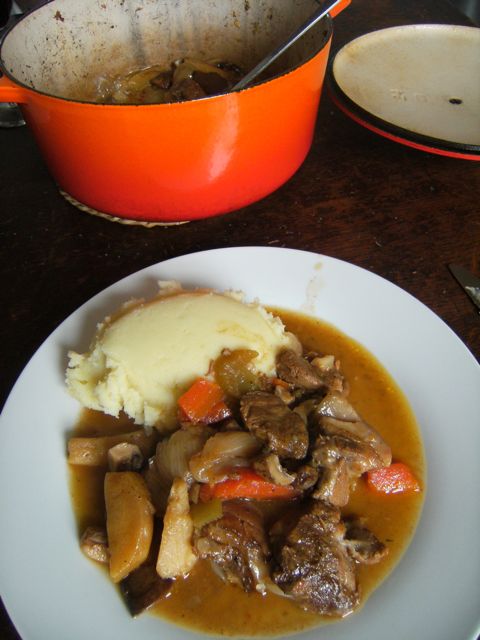
When you’re ready to start to cook (and precisely when that might be in relation to when you’re going to eat is again optional – from a minimum of two hours to a whole day or more before, the longer, within reason, the better.  Whenever it is though, hopefully you’ll have had the opportunity to remove the marinading meat from the fridge, if that’s where it’s been, long enough ahead to come back up to room temperature) then start by gently browning the meat in a big, solid casserole.  While the meat is browning roughly chop a carrot, an onion and a stick or two of celery (I cut my onion into slim wedges and my carrot into batons, but exactly how you chop is up to you), and throw them in once the pork has taken on some colour (with pork I just tend to add the veg to the meat in the pan, rather than removing the meat and adding back later on – mainly because I’m not looking to get the same kind of deep colour on pork as I would be on red meat or chicken skin, so I start at a lower temperature, rather than with the heat up high then turning it down).  Throw in a bay leaf, too and maybe some sage leaves or thyme.  Once the veg is starting to soften perceptibly, pour over any remaining liquid from the marinade, and enough cider to just about two thirds cover (this doesn’t need to be precise, but be careful not to drown your dish), bring to a gentle simmer and transfer to a low oven.

How low, and therefore how long for depends very much, like the marinating, on how long you’ve got, and to a certain extent on how many people your cooking for and therefore the sheer volume of stew we’re dealing with.  About 170 for an hour and a half to two hours would probably do it at a pinch.  150 for two to three would be better.  And in an ideal world, 130, or even lower for three, four or even five for a big pot in a good low oven.  Basically as long as you’ve got at as low as you can, until the meat can be cut with a spoon and the fat’s turned to an unctuously sweet, slightly sticky jelly.  And preferably, as ever with a stew, the day before you were planning on serving it.


Whichever, about half an hour before your stew’s due to serve (or when you start reheating it if you did do it the day before), gently fry up some thickly sliced (or halved if they’re small) mushrooms and a couple of apples peeled, cored and cut into lengthwise quarters, then eighths.  Get a bit of golden colour into the apple wedges then add them and the mushrooms to the stew – checking the seasoning at this point, and the liquid level, you might want to top up with a little extra cider or a splash of stock at this point – for the final half hour or so of simmering.

I’d serve with mash on a more wintery kind of spring day, perhaps mash with a dessert spoon of mustard stirred through it, or with rice, perhaps, of a springier evening.


This recipe would work equally well with pork belly too.


Monday, 31 October 2011

A tender heart, tenderloin and a big fat chop


As I said in my last post, our friend Claire loved her pigs, Bert and Ernie, but not too sentimentally.  It was perhaps in part, subconsciously at least, an attempt to test out the limits of her sentimentality that led me to suggest that the first part of either of them that should be consumed was the heart.  If so, then it’s possible that was unkind of me. If, though, it was indeed a test, then it was one she passed with flying colours. 

I could, of course equally claim that there might be some ritual or symbolic significance to the eating of the heart, as representing affection, or more importantly respect, for the slain beast.  That would of course be at best disingenuous, at worst spurious.  Or, to put it more bluntly: a load of old bollocks.  Not that the affection and respect weren’t there, because they certainly were; it was, I’m sure, purely the element of symbolism that was absent.  Nevertheless, I have to admit that there was a feeling, even in my own cynical, rationalist heart, that it was in some way appropriate, even if only on the level of the essentially meaningless gesture, to begin the consumption of Bert and Ernie, with one of their own hearts.  Or part of one, at least: half of it being as much as we needed for a starter salad for the three of us.


On a purely rational, pragmatic level, then of course it was appropriate: offal of any kind is best consumed as fresh as possible, and I can’t imagine there will be many opportunities in my life to consume offal as fresh as this was.  The livers were enormous, and, speaking personally of course, the best way to cook kidneys is long and slow in a stew, and preferably then baked into a pie.  So for a quick meal for three, that pretty much left the heart.


Heart, I think, is a much overlooked item of offal, seldom seen anywhere other than the menu at St John’s or the now many St John’s influenced nose-to-taileries, but it has great depth of flavour without being too pungently offally for even the most delicate palette, and I think a perfect balance of chewiness and tenderness.  And because it’s generally overlooked, even if you don’t have a friend who just happens to have slaughtered a couple of pigs, if you have a half way decent butchers anywhere locally, they’ll happily supply hearts (pig, lamb, chicken, duck – I have yet to try cow’s which might just be getting a bit big and tough, but I’d happily give it a go) for next to nothing.


A pigs heart, obviously, is a big, powerful well exercised, muscle – particularly the heart of a pig that is both active and - without wishing to be unkind - frankly at least marginally overweight.  So it’s a good idea to slice it thin.  In this instance I cut half of one heart into thin strips, no more than 3 or 4 mm thick, which I then marinated in salt, pepper cider vinegar and olive oil for about half an hour (had I remembered that Claire has great deep beds of sage growing right outside her front door I’d have probably added a few leaves of that too), before searing briefly in a hot pan and tossing into a basic leaf salad of baby gem, pea shoots and herbs (parsley, basil, mint & chives) with a simple dressing that was essentially the same as the marinade.  It was utterly delicious.  And, damn it, whatever the risk of appearing sentimental or superstitious, it seemed highly appropriate.


For our main course I took a tenderloin and roasted it with a paprika crust, served up with sautéed potatoes and a quick butterbean and pepper stew.  I’ve described the method for the tenderloin here; for the butterbean and pepper stew just cut a couple of bell peppers (I did one red, one green) into thin strips and fry these gently in olive oil with a finely sliced clove of garlic until just softening, then add a tin or a jar of butterbeans and a glass of sherry (white wine will do, or even marsala or Madeira if you have those to hand and not sherry).  Cover with a lid and allow to simmer away gently for about twenty minutes until the sherry and the pepper juices have combined with the oil into a sweet, glistening sauce.  Add salt and pepper to taste at the end, and a sprinkling of fresh leaf herbs.  This was an entirely improvised but pretty convincingly Spanish style dish, which, like most Spanish style dishes, made an excellent accompaniment to the pork.


It was a delicious meal, and a profoundly satisfying one on several levels.  Most of all, I hope, for Claire.  Certainly, given the current trend for locally sourced produce, it could scarcely have been a more fashionable meal.  Our pork could have been more locally sourced - if we had taken our plates down to the end of the garden to eat it.  As it was, eating in the conservatory as we did, I guess it was sourced from all of about twenty yards away.  I don’t know that it’s necessarily true that local is always, inherently, better; but if you were setting out to make the case that it was, you could do worse than call this meal as a witness…


Becca and I returned home the following morning with a huge shoulder joint, a great slab of belly and three big fat chops.  One of which, at the best part of a couple of inches thick, was big and fat enough to cook up on its own as a mini roast for the two of us a couple of days later.


First I marinated it for an hour or so in cider vinegar, olive oil, salt, pepper and a sprinkling of small sage leaves.  Then I browned it briefly on both sides, in a pan large enough to take both the chop and an apple, peeled, cored and cut into wedges, half a bulb of fennel thickly sliced and a stick of celery, chunked.  Then I transferred the pan to an oven preheated to about 200, and roasted it for half an hour.  This actually turned out to be marginally too long to my taste – although I’m sure it would have been spot on for many people – so perhaps 25 minutes would be perfect, although there’s no point giving exact timings in cases like this as there are simply too many variables in the size, weight and thickness of the chop, oven temperatures and personal tastes in what constitutes perfectly cooked anyway.  Still, even if – for me- very slightly overcooked, the thick layer of fat protecting and lubricating it kept this chop deliciously moist and tender.  


I served it up, as well as with the roasted apple, fennel and celery from its own pan, with roast potatoes, parsnips and shallots, and pickled red cabbage.  This was a perfect weekday roast for two, all - apart from the marinating, and, honestly, if need be, you could reduce that to fit within the time the rest of the prep took - done in just about an hour.   


All that remains to say is thank you Claire.  And thank you Bert and Ernie.

Friday, 28 October 2011

A night at the butchers


Becca and I drove up to Suffolk just for the evening last week, to attend the butchering of our friend Claire’s two pigs.  They were her first pigs, reared and raised at the bottom of her garden, a space they shared with one cat, a dozen hens and a cockerel called Kevin.  The pigs, Bert and Ernie, were well, but not over sentimentally loved, very well fed, and lived what appeared to be very happy lives, in pig terms.  I couldn’t claim they died happy, but I can pretty confidently state that they lived happily up until the point they were, as humanely as possible, dispatched.

Whether or not they died happy, they undoubtedly died fat, which in this case, I suspect, amounts to much the same thing, fattened as they were in the last few weeks of their lives, at least, by this autumn’s bumper crop of acorns.  Acorns and just a little bit of procrastination on Claire’s part, as she put off committing, or at least commissioning the fell deed.  Acorns, procrastination and then finally a snuffle, which one of them – Bert, or Ernie, I’m not sure which – succumbed to shortly before the originally scheduled date, buying them both a stay of execution of about a month, while the administered antibiotics cleared their systems.

Eventually, though, their time had to come, which it did on the Monday of last week.  On Thursday, Becca and I joined Claire after hours at her village butcher’s to witness the final part of Bert and Ernie’s journey from pigs to meat.  From porkers to pork. 

I had hoped, I must admit, that there might have been the chance to do more than witness it, that the chance might arise to participate more actively, and I had optimistically sharpened my knives and brought them along.  As it turned out, when Claire had said that the butcher was going to show us how to butcher a pig, it meant he was going to let us watch what he did, rather than give a hands on lesson in butchery.  Which is fair enough.  He was doing this as a favour, and there was quite enough for the butcher and his lad to be getting on with as it was, without standing over a couple of cack handed amateurs, trying to impart the basics of his trade, and then, no doubt having to salvage the results of their hackery and convert it into serviceable joints of meat.


So we stood to the side and tried to keep out of the way as we watched and admired the skill and speed with which he applied the tools of his trade – of which there were just four: hacksaw; big knife with a ten or twelve inch, curved, slightly spatula shaped blade; small knife with a narrow, tapering six inch blade; big heavy cleaver – to the four vast sides of beheaded and halved pig that hung in his cold store.  A cold store, incidentally, that smelt headily mouth watering from the herbs in the great cascading bunches of sausage strings hung from ceiling hooks.


 When Becca and I arrived the first of these sides had been jointed and most of it set aside in a second cold store (alongside a whole wall lined floor to ceiling with hanging game birds – pheasant, partridge and mallard), destined for curing and smoking, before coming back to Claire in the form of bacon and gammon.  A large plastic palette tray was already more than half full of meaty off cuts intended for sausages and a giant steel pan under the table was similarly filled with trimmed bones, fat and skin.  Both of these would be filled to overflowing well before the end of the process.  It’s possible that Claire in her understandable keenness not to waste a scrap of her cherished first pigs will end up with more pork stock than she will ever need.  She will also end up with a lot of sausages, but I don’t think it’ll add up to more sausages than she’ll ever need.  I’m not sure such a thing exists.  And that is in no way intended as a personal slight on Claire…


These pigs were big.  A measure of how big is that one of the shoulders was cut into a joint that I’d heard of, but don’t recall ever having seen in the flesh, called a hand of pork.  Now Matthew Fort, if you click on that link, says nothing about how many his recipe will feed – which normally means a standard 4, as is the stated case for this one – but he does mention that he picked up his hand for 3.99 from his local farmer’s market, and even though he was pointing out what a bargain it was, I think he’d have made rather more of that point had it been capable of feeding 8.  Which Claire’s – or rather Bert or Ernie’s – will do, conservatively.  Probably 10.  Hungry people.  He also talks about slow roasting it, at a low temperature in two and a half to three hours.  That’s simply not going to do it for Claire’s hand - that baby’s an all-dayer, if ever I saw one, and that was certainly the butcher’s recommendation.  I sincerely want to be there when Claire takes the hand out of the freezer, but I have a feeling that it might just be saved for her family Christmas.


There was scarcely a joint cut from Bert or Ernie that would feed less than six, and the meat came wrapped in a thick blanket of fat, inches thick in places.  The butcher indeed clearly felt that Claire had allowed them to get too big, and much too fat, which from his point of view you could see might be a problem – both as the man who had to manhandle the carcasses, and who would, in other circumstances have to try and sell the meat to a fat-phobic public.  You can see his point.  Claire, and Becca and I, on the other hand, just looked at that deep layer of snow white fat, and the marbling that ran through some of the joints like a sirloin in a way you simply never see with pork, and thought flavour.  And luscious, succulent flesh that would be more or less impossible to dry out, even if you committed the cardinal sin of overcooking.  What the butcher saw as a flaw, we saw as a rare prize.  And the very thing that marked this meat out as special.  You really wouldn’t be able to buy pork like this in the shops, it seems, not even from the very best butchers.  The one thing that concerned Claire was that she’d let Bert and Ernie get too old - 10 months by the time they went to slaughter, rather than the standard 6 - because, as their names suggest, they were male pigs, and as male pigs reach maturity their hormones can make them quite unpleasant.  Which is the case with the males of many species, you might observe, but specifically in the case of pigs it can lead to something called ‘boar taint’ spoiling the flavour of their meat.  There was, however, not the merest whiff of male pig pheromone in either Bert or Ernie’s meat.  They may have been big, fat boars, but they were nice boars - and, like the real Bert and Ernie, there was not the slightest hint of inappropriate sexuality about them...


In little more than an hour, three plastic palettes were stuffed to overflowing with every cut and joint of pork imaginable.  And there are many.  One of the things that most struck me was how many choices there were to be made at every stage of the process.  We’re all familiar with the broad distinctions between the cuts – shoulder, loin, belly, ribs, chops – but not necessarily in the proliferation of different ways those cuts can be shaped and subdivided.  I think Claire got at least one example of pretty much every option, but it’s impossible to be sure.


What I can be sure of, because I’ve tasted some of it, is how good each of those many cuts is going to taste, and I’ll cover that, at least some of it, in my next post.  Of course the thing that you, or your friend, has raised for food by your/their own hand, be it fruit, vegetable or animal, tastes better than anything bought in a shop.  And of course at least part of that may be psychological, not that that would make it any less real, even if that were all it was, particularly if part of the psychology in play was the knowledge that the animals that had died to provide your meat had lived happy lives.  But psychology aside, the flavour, succulence and tenderness of the meat we got from Bert and Ernie is real, and stands as an example of something significant.  It goes to show, as if we needed showing, that the best meat is obtained from animals that have led good lives, and suffered, in relative terms, a good death.


Now obviously not everyone can raise their own pigs down the end of their gardens.  And not every pig can lead as comfy, and cosseted a life as Bert and Ernie did.  But if more of the pigs that more people ate led lives that were closer to Bert and Ernie’s than they were to a Danish factory porker, then the world would be, in a small but significant way, a better place.  For pigs and the people who eat them.


Friday, 16 September 2011

What we did on our holidays (woodfire grilled pork ribs)


Becca and I just returned from a week away, up a mountain in Andalucia.  The same mountain, or its immediate neighbour, that appears in the background of the photo of me up a mountain in Andalucia, taken last year and featured in my post on wrapping fish in ham back in March of this year.  We had returned to – or near to, we were actually staying in a converted shepherd’s hut about 4km out of town - Trevelez, the village in the Sierra Nevada where jamon is sent to become Serrano, to enjoy more of their ham, and other delights.

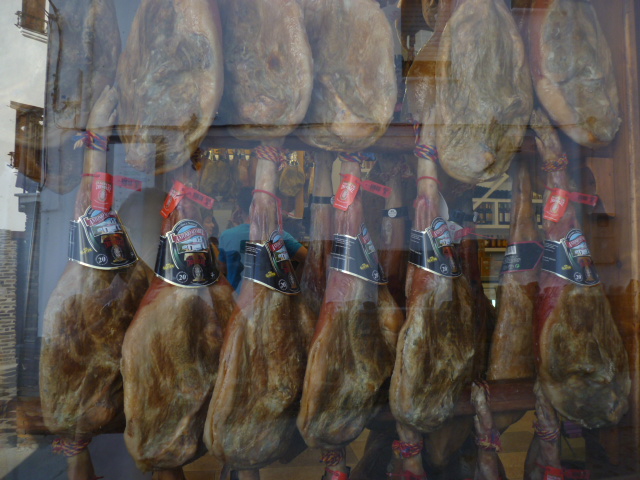
A typical shop window in Trevelez
One day it is my firm intention to travel to a place like Trevelez with its wealth of pork products, or, say to Catania, with its fabulous fish market that Becca and I visited a couple of years ago, in sufficient style, for long enough and/or with enough people along for the trip, to do some serious cooking – and, in the case of Trevelez, to purchase a whole leg of jamon, which you can do for as little as around €40 (!).  As it was, this time, we were in a hovel – very lovely, but a hovel, nonetheless, with a three ring stove fired by gas from a bottle, and no oven.  Plus the usual selection of blunt, battered edged knives that you find in holiday rentals (I know they start off as cheap knives, which is a big chunk of the problem, but what do people do with them to put the kinks and unintended serrations into their blades that you always find?  I’m at a loss).

and another...
Travelling in sufficient style here means not only spending more on the accommodation, but also NOT flying Ryanair, and checking your bags into the hold so you can actually take your own knives.  Although surely there’s a market out their for foodie holiday lets – properties that are advertised, and can charge premium rents, on the basis of having well equipped kitchens and a set of decent knives (I wouldn’t mind paying an extra deposit on the knives).  Even a properly stocked spice rack, and basics like oils and vinegars laid on, because it’s a pain in the arse, not to mention an unnecessary cost, and one fears a horrible waste, to have to go and stock yourself up with these items for a week, knowing full well that you’ll use only a fraction of what you buy and will then have to leave them behind for the same kind of people who’d left you a six pack of energy drinks and a tin of frankfurters and beans…

I daresay such places already exist, just not in the price bracket Becca and I do our holiday shopping.  So 3 rings, no oven and blunt knives it was, then.  Not even a pepper grinder, for crying out loud (although fortunately the mountain sides round Trevelez are covered in loose scree from which we were able to forage a remarkably effective pestle/mortar combo).  So a certain amount of improvisation became all part of the culinary fun.  On the considerable upside we had free access to fruiting plum and almond trees, strawberry beds and a fecund veg patch that was effectively a ratatouille jungle, with tomatoes and peppers growing in tremendous variety and profusion, more courgettes than two people could possibly hope to deal with, and just a bare sufficiency of aubergine.  And although we had no oven, we did have a fine brick and stone built barbecue, and as much dry wood as we could carry back off the mountain to fuel it, which I guess makes it a South African style Braai, as much as a barbecue.

Beautiful but innefective.  My first attempt at building a cooking fire (perhaps not a braai)...

With cooking over a wood fire in mind I got a rack of pork ribs from the Supermercado & Carniceria in the village down the hill (which was no kind of a fancy shop but did have a selection of fresh and cured meats - mainly pork and pork products, but also chicken and a little beef - that would be pretty much unimaginable in the general store of any British village of comparable size, let alone remoteness), and had the nice lady split it with her big, sharp cleaver. 

On getting the ribs home I improvised a marinade from the somewhat random cupboard stores that were to hand.  Fortunately, and this was clearly dependent on luck, with nobody’s judgement entering into it, what was to hand consisted of dried garlic, cumin powder, hot paprika (pimenton picante), dried chillies and cinnamon, plus the sherry vinegar that I added to the general store, and several jars of the fantastic, richly herbal, local honey – the miel de Alpujarras – that we remembered well from our last trip to this neck of the woods.  This, along with salt, pepper (once I’d found the appropriate grinding stones) and good local olive oil, made the basis of a fine, sweet/hot dryish rub for the meat.  The only thing I probably would have done differently if at home would have been to use fresh garlic and chilli (pasted together in the garlic crusher) rather than dried, maybe added crushed fennel seed, aniseed and star anise, and probably left out the cinnamon – but I’m not so sure that last omission would necessarily have been an improvement.  And I know a lot of serious BBQ aficionados would argue that the best marinade for your meat is a dry one - but then some of them might also advocate the inclusion of ingredients like Dr Pepper, so we can pick and choose which elements of BBQ lore to follow.  If a BBQ aficionado told you to jump off a cliff, would you do it?  With or without a Dr Pepper…?


My first attempt at building a wood fire to cook over was an abject failure.  A perfectly good fire of the kind you’d happily snuggle into an armchair in front of with a good glass of red wine, or maybe port of a winter’s evening, or even sing songs round of a midsummer night, but just nowhere near enough heat to cook over.  That night I retreated to the kitchen and cooked up some patatas pobres with fried chorizo and morcilla on the three ring gas hob, which was quick and delicious, and put the ribs back in the fridge to marinate for another twenty four hours – so no loss at all, if anything a net gain…

Emergency patatas pobres with chorizo & morcilla.  Disaster  pleasantly averted...
The second fire was much more effective.  First time round I think my mistake had been to build it up with small branches and then get a good big log going as the smaller branches burnt out, just as you would for a fire in a hearth at home.  The problem with that is that it’s actually hot embers you want to cook over not flaming wood, and the big log just burns too long and slow.  The second time, I started earlier, which was a big, basic step forward, used several small to medium sized logs as the core of my fire and kept adding smaller branches to burn faster and more fiercely, building up the heat and creating a greater mass of hotter ember.  This meant going through a lot of these smaller branches, but fortunately the hillsides around our cortijo provided a limitless supply of bone dry deadwood.


Once the wood was burning down to charcoal and ash, we lowered the grill over the fire to get good and hot before any meat came into contact with it.  And when we had a good heat going over glowing embers – hot enough that I could just about hold my hand 10 centimetres over grill level for 5 seconds without it actually starting to cook – then we were ready to go.  The well marinated ribs had been out of the fridge an hour now, so as not to hit the grill cold, the marinade itself contained plenty of olive oil so there was no need to add any to either meat or grill, it was just a case of whacking the ribs on, hearing that sizzle, smelling the flesh sear and the honey caramelise.

I gave them about ten minutes a side.  I wasn’t timing it, and there’s no point giving definitive cooking times for barbeque cooking anyway, because there are simply too many variables - how hot your coals are, how high above them is your grill, and how confident are you about eating your pork pink.  With regards to the last, in this case I think a lot of people would have gone a good couple of minutes a side over my ten, but I think my ribs would have been tastier, juicier, more tender and just generally more satisfyingly carnal than theirs.  I’ve talked about this before:  If your pig meats good, you can serve it pink – maybe not raw and bleeding like you might the flesh of cow, but distinctly pink.  If you think your pig meat might not be good, you really shouldn’t be eating it anyway.

Lunch on the terrace.  Not a bad view for a hovel...