Friday, 27 April 2012

My fish stew (or Bouillabaisse-ish, if you like)


I hate to be a bore, but this weather, eh?  We’d just got all geared up for summer after the hottest March ever, braced ourselves for drought, and then April comes along with not just showers but torrential rain, thunder and lightning, hail, snow, gale force winds and all kinds of meteorological whoopass.  And sunny spells.  I wouldn’t say you hardly know what to wear – wrap up warm under a sturdy waterproof, obviously - but knowing what to eat is a bit of a dilemma.  Jersey Royals and asparagus are with us, but it really doesn’t feel like a time for potato salads, let alone firing up the Barbie – unlike this time last year (one of the advantages of keeping a blog is having a record of these things).  And yet, much as we love ‘em, a hearty wintery stew would feel like a retreat into darker days and so quite the opposite of comforting, which would not just be wrong, but unfair to the stew.  But yet again, look out of the window at the slate grey skies, and listen to the wind rattling the rain battered panes, and a stew feels like just about the only appropriate thing.

So how about a fish stew?  Fish because it always at least hints at something light and summery, stew, well, for the reason’s outlined above.  And because, of course, a good fish stew is damned tasty at any time of the year.

Fish, of course, these days is no longer the cheap option it once was – for good if unfortunate reasons.  However, even today, one of the great things about a fish stew is that it’s a great way of making a wonderful meal out of the least regarded, cheapest (if not ugliest) fish on the slab.  Indeed a proper fisherman’s stew is made out of all the bits of the catch that don’t sell at - or it’s not even worth his while taking to - the market.  Essentially the fish you can’t give away – not that you’d guess that from a check of the prices charged for bouillabaisse in its ‘home’ port of Marseille.  Canadian writer Taras Grescoe, in his book Bottomfeeder (essential, if not particularly appetising, reading for anyone interested in the good but unfortunate reasons for the exorbitant price of fish these days) claims you can’t now get bouillabaisse in a Marseille restaurant for less than €50, and while by means of a little Googling I did manage to dig up a menu from a well recommended restaurant offering it for as little as €47(!), it’s still really quite a lot for, as Grescoe points, out a dish originally made from unsaleable fish, sea water and stale bread.

And, of course, Marseille being France, and bouillabaisse being a jewel in its cultural, let alone culinary crown, you can’t get away with mentioning it without that mouldy old chesnut, the whole tedious authenticity debate cropping up.  Again.  They (that is, the Marseillais, or more particularly a cabal of Marseillais restaurateurs) even have a charter – for which thanks again to Grescoe for bringing it to my attention.  A charter which, rather marvellously starts with the statement that “It is not possible to standardize cooking”, before, obviously, going on to do exactly that.  Nonsense, plainly, but I’m not sure I’d go as far as the ‘Bouillabaisse Milkshake’ offered at Marseille restaurant Une Table, au Sud by Lionel Levy, a chef originally from Toulouse (brave man).  Nor get as snotty about it as Clare MacDonald of MacDonald in the recipe for Bouillabaisse Escossaise in her book Delicious Fish, in which she pronounces herself not at all sorry that it’s not “proper bouillabaisse ” because she finds “Mediterranean fish are pretty drab at the best of times, over endowed with bones, and this fish soup is far nicer, made with the delicious fish caught in the chilly waters of the Atlantic Ocean or the North Sea.”  Which merely leads me to wonder why she bothered calling it Bouillabaisse Escossaise in the first place.  Why not just fish soup?  Or stew, which is what I’ll call mine.


Like Ms (or Baroness, if she insists) McDonald though, mine was, on this occasion made with fillets of fish from the Atlantic or the North Sea  (or probably more accurately, the English channel), Pollack and whiting to be precise, two fish that, if not exactly fishmongers scraps, remain thoroughly reasonably priced for the excellent reason that their stocks, and the fishing methods used to catch them, are largely sustainable.  Although, that said, in double checking their status for the purpose of this blog post, I discovered that I had bought them fresh at the one time of the year (their spawning season, January-April in the case of pollack, March-April for whiting) that they’re best left in peace.  But never mind, from next week (at time of writing) you’re in the clear. 

Unlike her, though, I would never claim that my fish stew was far nicer than any bouillabaisse, although I’m sure it will be nicer than some.  That said, some of my fish stews will be nicer than some of my other fish stews, because, like most things, I make it slightly different every time*, depending on mood, ingredients to hand and what fish looks best on the fishmongers slab (which is always the approach to take when planning a fishy dinner).  I also have to say it has not been my experience that Mediterranean fish are drab either (particularly not, most memorably from the fish market in Catania in Sicily), but that’s a whole other issue.


My fish stew (or Bouillabaisse-ish, if you like)

White fish fillets (half and half Pollack and whiting on this occasion)
Fish stock
Vermouth (or any white wine will do)
New potatoes
Aromatic veg: red pepper, red onion, fennel**, celery
Garlic
Tomatoes
mushrooms
Fresh red chilli
Salt
Pepper
Fresh hard herbs: thyme, rosemary, sage
Fresh soft herbs: Basil, parsley, the young yellow leaves from the celery heart
Lemon

Cut your fish fillets into small portion sizes, lay them in a shallow dish and sprinkle with salt, pepper and the zest of half a lemon, then pour over the lemon’s juice  and a glass of vermouth (or wine).

Peel your potatoes and cut them in half (I prefer to do that lengthways, for purely aesthetic reasons), put them in a pan and just cover with cold fish stock***, bring to the boil and cook for 10 minutes, then strain the hot stock off into a bowl or big jug.

Meanwhile roughly slice your aromatic veg, and throw them into a big heavy based pot or casserole, along with the hard herbs, garlic and chilli – all chopped reasonably fine and cook them gently in plenty of olive oil, till softening. 

Peel, deseed and roughly chop your tomatoes (allow 1 averagely big tomato per person), and add them to the pot along with the mushrooms (I favour chestnut mushrooms, halved or quartered depending on size)


Once the tomato has just started to collapse, add the potatoes along with the stock they were partly cooked in, and a glass of vermouth (or wine).
 
Cook till the potatoes are just about fully cooked, then add your fish, cover for just a couple of minutes till the fish is cooked through, sprinkle over the soft herbs and serve in deep dished plates or shallow bowls, with chunks of good bread on the side.


*The differences on this occasion were:

*  We where at Becca’s family home for the weekend, and there was simply no fennel to be had at Waitrose in Henley (which would never happen at the TFC in Dalston), so I just left it out, but compensated by adding some lightly pestled fennel seeds along with the hard herbs.

**  If you have bought whole fish and filleted them yourself, you can simply make a stock from their bones (or if you got the fishmonger to fillet them for you and asked for the fish ‘frames’).  If not, then if you’re like me there is always either fish stock, or fish skeletons, probably both, in your freezer.  If neither is the case, you’ve just got fillets of fish and no means to make or thaw out a fish stock then never mind.  Just par boil the potatoes in well salted water (it should taste like sea water – which is what the fishermen of Marseille would have used for the original bouillabaisse), and use a little of that, and plenty of the vermouth as the liquid for your stew.  It’ll be a little less fishy, a good bit more winey, and just as delicious, just in a different way.


Tuesday, 17 April 2012

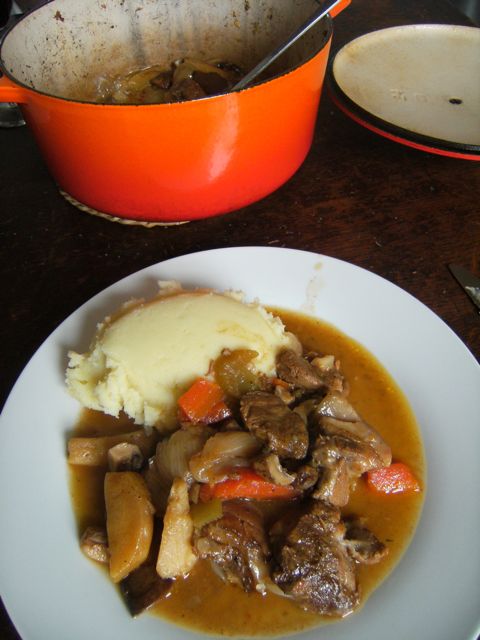
Springtime for… pork shoulder in a fruity stew


Half way through April now – sorry I haven’t been updating the blog much recently, but real life does have a habit of getting in the way – and spring, I guess is in full swing now.  Although in many ways it doesn’t really feel that way, perhaps on account of all the news bulletins being full of drought stories, when, that is, they’re not full of stories of half the country being brought to grinding halt by snow (as predicted right here, people!).  Although perhaps we’ve become accustomed to seeing sinister patterns and isolating freak abnormalities in our weather - and extrapolating day to day weather into climate - whereas in fact it’s perfectly ordinary, unremarkable and indeed characteristic of spring time that the weather might swing from high summer one day to midwinter the next.  Not, I hasten to add, that I’m sceptical about climate change, let alone in denial.  Unlike this idiot.

Whatever its causes, the current state of the climate – sorry, the weather – makes it tricky to plan ahead when it comes to deciding what’s for dinner, having no way of knowing whether tomorrow will be a porridge for breakfast or a salad on the roof terrace for lunch kind of a day.  So what’s called for at this time of year are things that are versatile in the meals that we can make from them – things like fish, for instance, or the chicken I’ve covered in my last couple of posts.  Or we just say, to hell with it, we don’t seem to have had pork for a long time (hard to believe for regular followers of this blog as that may be) and that’s a nice looking piece of boneless pork shoulder reduced to a bargain price, let’s have that.  Which is what I did last week.  That said, I did consider the weather when it came to deciding how to cook it.


I could just have roasted it, of course, and I’m quite sure that would have been both delicious, and weather appropriate – when is roast pork ever not seasonally appropriate (apart from Passover, obviously, or Ramadan…)?  But I had some fruit – an orange and a couple of apples just starting to go soft in the bowl, so I decided a fruity pork stew would be just the thing – big and hearty enough should the day turn out bitter and bleak; bright and fresh flavoured enough should it be bright and sparkly.


I started by chopping my joint into big chunks, rough cubes a good couple of inches or more a side.  Then I put them into a bowl and grated the zest of my orange over them, then added crushed garlic and chilli, a teaspoonful each of paprika and sumac and a generous sprinkling of fennel seeds, black peppercorns and sea salt, gently pounded with pestle and mortar, the juice of the orange and a good glug of olive oil, rubbed it all together and put the bowl in the fridge to marinate overnight.  The precise ingredients and proportions for your marinade is, of course, optional, being entirely up to you and the contents of your store cupboard, as indeed is the overnight thing.  If you’re cooking for tonight then just give it as long as you can, but in that case don’t refrigerate it, the action of the marinade will be speeded up at room temperature.


When you’re ready to start to cook (and precisely when that might be in relation to when you’re going to eat is again optional – from a minimum of two hours to a whole day or more before, the longer, within reason, the better.  Whenever it is though, hopefully you’ll have had the opportunity to remove the marinading meat from the fridge, if that’s where it’s been, long enough ahead to come back up to room temperature) then start by gently browning the meat in a big, solid casserole.  While the meat is browning roughly chop a carrot, an onion and a stick or two of celery (I cut my onion into slim wedges and my carrot into batons, but exactly how you chop is up to you), and throw them in once the pork has taken on some colour (with pork I just tend to add the veg to the meat in the pan, rather than removing the meat and adding back later on – mainly because I’m not looking to get the same kind of deep colour on pork as I would be on red meat or chicken skin, so I start at a lower temperature, rather than with the heat up high then turning it down).  Throw in a bay leaf, too and maybe some sage leaves or thyme.  Once the veg is starting to soften perceptibly, pour over any remaining liquid from the marinade, and enough cider to just about two thirds cover (this doesn’t need to be precise, but be careful not to drown your dish), bring to a gentle simmer and transfer to a low oven.

How low, and therefore how long for depends very much, like the marinating, on how long you’ve got, and to a certain extent on how many people your cooking for and therefore the sheer volume of stew we’re dealing with.  About 170 for an hour and a half to two hours would probably do it at a pinch.  150 for two to three would be better.  And in an ideal world, 130, or even lower for three, four or even five for a big pot in a good low oven.  Basically as long as you’ve got at as low as you can, until the meat can be cut with a spoon and the fat’s turned to an unctuously sweet, slightly sticky jelly.  And preferably, as ever with a stew, the day before you were planning on serving it.


Whichever, about half an hour before your stew’s due to serve (or when you start reheating it if you did do it the day before), gently fry up some thickly sliced (or halved if they’re small) mushrooms and a couple of apples peeled, cored and cut into lengthwise quarters, then eighths.  Get a bit of golden colour into the apple wedges then add them and the mushrooms to the stew – checking the seasoning at this point, and the liquid level, you might want to top up with a little extra cider or a splash of stock at this point – for the final half hour or so of simmering.

I’d serve with mash on a more wintery kind of spring day, perhaps mash with a dessert spoon of mustard stirred through it, or with rice, perhaps, of a springier evening.


This recipe would work equally well with pork belly too.


Saturday, 31 March 2012

More Spring Chicken: Leftovers


Following on from my last post, on coq au vin, I’m sure you’ll have been waiting all a-tremble to find out what we did with the leftovers.  No?  Oh…

Well maybe you should have been, because of course the real glory of chicken lies in the leftovers.  Lovely as a freshly roast chicken is, many would argue - and I’d be hard pressed to say they were wrong – that its flesh is even better cold the next day.  Even if you don’t subscribe wholly to that school of thought, what kind of person would you be if you weren’t even slightly disappointed should a roast chicken not yield up enough pickings from it’s carcass for a sandwich the next day?  Not my kind of person, that’s for sure.   But even if you were that kind of person then you couldn’t deny that the carcass itself, converted into a rich, brothy stock, and thence into soups, risottos and greatly enhanced sauces, prolongs the culinary life of the single bird you started with at Sunday lunchtime, say, well into the middle of the week, if not beyond.

Even leftover coq au vin (which was my starting point from my last post), which you might be tempted to simply reheat the next day, and I couldn’t blame you, is also easily adaptable into a different meal entirely – and that’s the coq (along with its vin) itself I’m referring to, not stock derived from its bones.  And yes – I do pick the bones off the plates at the end of the meal and use them for stock.  I’m not proud.  And even if you, or your guests have gnawed and sucked at those bones, I really don’t think we have to worry about that, after all the process of being turned into stock involves those bones being boiled for hours.  Probably not quite the done thing in a commercial kitchen (or strictly legal, what with health & safety going mad and all that…), but perfectly fine at home.  More than fine, I’d say, more like an obligation, on grounds of thrift, consumer ethics and crimes against flavour (and the waste thereof).


Still, between the coq au vin and the stock came the next day’s dinner, for which I stripped the remaining meat from the bones (and set those aside with the plate scrapings) then added the now boneless and shredded coq au vin to a pan with some sliced chorizo piccante and a handful of cherry tomatoes, halved and fried till just starting to soften, then added a sprinkling of green olives (you can pit them yourself or just chuck them in whole with appropriate warnings to your fellow diners – but don’t buy them ready pitted, they’re really not the same.  To the extent that I’m afraid they don’t really count as olives, not in my book).   Served as a sauce for a bowl of pasta, in this case, gnocchi, this made a very quick, thoroughly delicious and entirely different meal from the night before.


More recently, in the current spell of summery weather, I roasted a chicken.  I’ve blogged on roasting before, several times so I won’t risk boring you all re-covering old ground, but while on the broader subject of leftover chicken it would be just perverse not to mention it at all.  Or to point out that it’s not just chicken sandwiches that you can do with cold roast chicken, good though a chicken sarnie can definitely be.  First use made of the leftovers of this particular chicken was a simple, delicious and really rather attractive warm chicken and potato salad.


I just boiled a portion each of new potatoes, finely dicing and frying some smoked streaky bacon while they cooked.  Once drained and while still hot I dressed the potatoes in olive oil and the juice and zest of half a lemon, a pinch of salt and plenty of black pepper.  Then I stirred through the cold chicken shredded from the roast bird’s carcass, along with a handful of capers.  Then it was simply a case of combining the warm potatoes, chicken and bacon with a simple salad of chicory and red onion, with torn fennel and celery leaves and serving it up.


Friday, 23 March 2012

Yes, Spring Chicken


I realise, to my shame, that a month has past since my last post.  I could claim to have been away, and while that would not have been a lie, it might legitimately be accused of being misleading, since I was only away for a long weekend out of that month.  Anyway, I’m back now, and need to stop slacking.

In the month that’s passed since last I wrote, we seem to have passed from a scarcely arrived winter to a well on its way spring.  The purple sprouting broccoli season is in full swing and (British) asparagus will be on us before we know it - indeed the social network  (Twitter in fact, but I don’t seem to be able to embed a link to Twitter, weirdly) tells me that at Hix Oyster and Chop House it’s already here.  Hoorah!  Doesn’t seem to have reached Dalston yet, but what price Broadway Market on Saturday?

Anyway, and in the mean time, at this time of the year, as winter slides, skips, or bounds into Spring, with the occasional leap sideways or back (let’s not forget we’re still some way short of the end of March – it could snow again yet…) it seems to me that chicken comes into its own.  And not because of any seasonal variation in the ripeness, freshness, quantity or quality of the chickens themselves, obviously – nor for the sake of food miles or the other ethical/philosophical reasons for advocating local sourcing and seasonality (and not buying Peruvian asparagus all year round).  No, mainly because you don’t really know what the weather’s going to be doing from one day to the next, and chicken is so versatile – equally well adapted to making a heart warming casserole or a light, uplifting salad.  Even in it’s simplest (which is not necessarily to suggest that it can’t also be it’s finest) incarnation – as plain roast chicken - only the finest of last minute adjustments need be made to tailor the meal to suit a bleak, wintry day, a glum autumnal one, or one that’s bursting with the bright promise of high summer – all of which we’ve had in the few weeks since last I wrote.

The other great thing about the versatility of chicken is that it’s ideal for a situation where you might have people coming over for lunch on Sunday, but plans are fluid, and you know it’s equally likely that they won’t.  Which, oddly enough, has happened a couple of times in the past month or so.

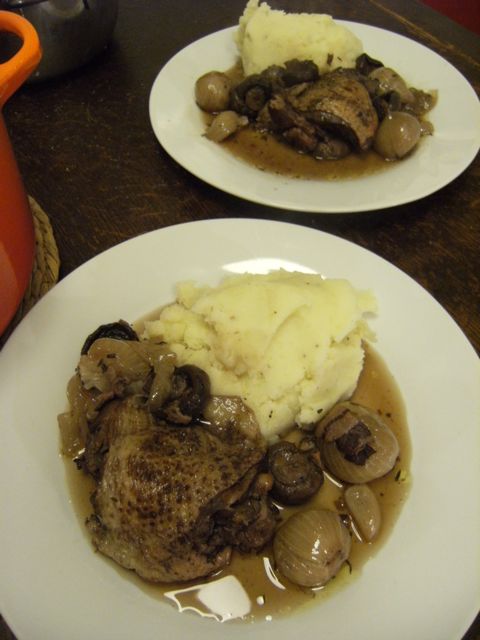
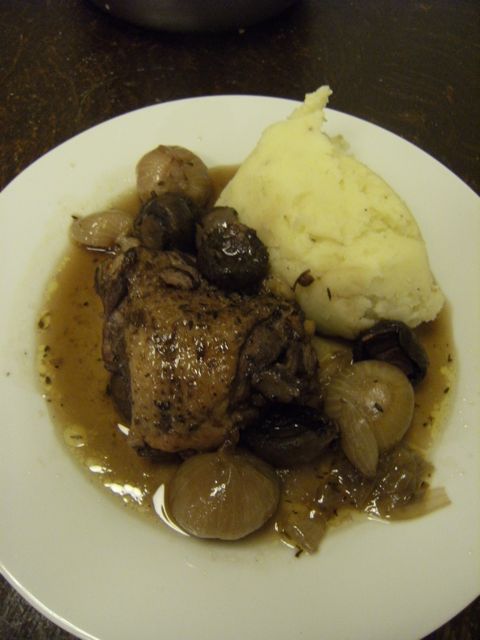
The first time was, in fact, just before I last posted, back when we had a brief but bitter cold spell, and actual snow on the ground, which proved the final nail in the coffin of the plans for Sunday lunch while providing the perfect setting for a big pot of coq au vin, served up with billowy mash.  One of the many virtues of coq au vin is that making enough for four, and finding you are only two for dinner, is not just no hardship, let alone any kind of a waste, it’s a positive bonus.

Coq au vin, at least the way I do it (which I’m sure would be scorned by purists, but let’s not re-open that old wound), really is ridiculously easy to do, and (by its own virtues, not mine) provides such a perfect balance of indulgent luxury and basic simplicity that it feels equally appropriate to serve up as a dinner party main course, or just for the two of you to eat on the sofa snugly watching TV as the snow falls outside.  It also happens to be what I was cooking for a party of twenty odd, at the moment that Sami, Mark Hix’s head chef at the Rivington at the time, called me to talk about my coming to do a trial shift with them.  So I feel it’s a dish that played its part in my becoming a chef in the first place.  That doesn’t necessarily put it in an entirely unambiguous place in my heart, but still.  It’s significant.


Coq au vin (for 4 this time, for a change)

1 good sized chicken (portioned but not boned) or 8 thighs and drumsticks*
4 rashers streaky bacon (or thick cut pancetta, or similar weight of lardons)
400g shallots
200g chesnut mushrooms
Garlic (8-16 cloves depending on big the cloves and how garlicky you like it)
1 fresh red chilli
1 lemon or orange (optional)
Thyme
Olive oil
250ml red wine
250ml chicken stock


*  By all means buy a whole chicken and portion it yourself (or get the butcher to do that for you), but I find it’s both easier and arguably even preferable to just buy chicken thighs, or those packs of mixed thighs and drumsticks you get from the supermarket – I know, and the chef in me cringes to recommend such a thing, but really, it’s not just the convenience, for coq au vin, or indeed any chicken casserole, the leg meat is best, the breast tends to blandness and overcooking.

First marinade your chicken (if you don’t have time, you can skip this, but it’s always worth marinading your meat).  Finely chop or crush (this is about the one thing I use a garlic crusher for) 4 cloves of garlic and about a thumbnail’s length of red chilli and rub it into the chicken, along with a good pinch of thyme leaves, plenty of salt and pepper, and enough olive oil to make a paste of all your seasonings and generously coat the chicken.  By all means add the zest and juice of a lemon or half an orange to the marinade if you want.  Ideally leave the chicken to marinate, covered, for at least an hour – or more in the fridge.

Peel your shallots – allow 4 or 5 per person and leave them whole.  If you can get mushrooms that are small enough, leave them whole too, otherwise halve or quarter them depending on size.  Peel the remaining cloves of garlic, and finely slice another thumbnail’s length of chilli.  Slice your bacon into broad ribbons – say, large postage stamp sized. Put your wine and stock in a pan to heat  up.

When your chicken’s marinated, heat a good sized, heavy bottomed casserole, brown the chicken pieces on all sides and set them aside.

Add the bacon  and gently fry till colouring, then add the shallots, the whole garlic cloves, the chilli and a sprinkling of thyme leaves – you may need to add a splash of olive oil at this point, or it may not be necessary.  Cook for about  7-10 minutes, then add the mushrooms and cook for a minute or two more before adding back the chicken.  Again, give it a couple of minutes, then pour over the stock and wine.  If you need more liquid, top it up with a bit more wine – but don’t drown the dish. 

Bring it all to a gentle simmer and cook for a long time.  I’m deliberately vague here, because although I think it probably best and easiest transferred to the oven, say at 150 for two, two and half hours, or even better, lower and longer, it will also cook perfectly happily, and probably marginally quicker just covered on the stove top at the lowest simmer you can achieve.  Or if you’re in a hurry, raise the simmer and you can have something perfectly fine in an hour or so.  One of the joys of this dish (and the benefits of using only leg meat, as opposed to breast which can overcook and dry out) is that it really isn’t fussy.  Another example of it’s inherent versatility and a reason why it’s as good an option for a supper for two as a dinner party for twenty.


Friday, 17 February 2012

A new definition of comfort food: Smoked Haddock Risotto


A couple of posts back I wrote about how, at this time of year and with the arrival of (finally!) some proper winter weather, then food-wise it was all about big meaty stews and hearty soups, and then I went ahead and wrote up a chickpea and spinach dish just to be contrary/prove there was an alternative.  That last bit was plainly unnecessary.  Looking back over the posts I’ve published since the turn of the year proves me to be a liar: it’s apparently not about meat, stews and hearty soups at all - or at least only one post in 9 covering any of that would certainly suggest not – it’s mainly about fish and veg.  So to continue in the same vein, here’s the smoked haddock risotto I promised in my last fishy post.  Of course, what this time of year is really about, foodwise, is comfort food, and this particular dish meets every kind of definition of comfort food I can think of.  In fact I’d have to say it pretty much provides a definition in itself.

First thing, of course, is to get yourself some smoked haddock, by which I mean natural smoked haddock, which you will find on the fishmonger’s slab in a pale and interesting shade of golden beige, NOT a lurid chrome yellow.  I the food snobbery and hate to make any statement that might be interpreted as such, but really – bright yellow smoked haddock?  Why?  Who the fuck’s idea was that, and how did it catch on?  Stop it, all right?  Just stop it.

Anyway, once you have your haddock, slice an onion and a bulb of fennel, in roughly equal quantities, and make a bed of them in the bottom of a suitable risotto making pan, along with a few fronds of the fennel leaves if the bulb has them, and a twist or two of black pepper.  Lay your haddock fillet on this bed and pour over a glass of white wine.  You need to cover the onion/fennel bed, but the fish itself doesn’t need to be submerged.  Cover the pan and put it over a lowish heat to bring the wine to the simmer and gently poach the fish for little more than a minute, maybe as many as two for a particularly thick fillet, once the wine is simmering.  Err on the side of underdone at this point.

Remove the fish and put it in a dish, pour the poaching wine over it, leaving the onion and fennel in the pan.  Add a little olive oil and a sprinkling of fresh thyme leaves – and maybe a little finely sliced or crushed garlic, although this is one of the few instances where I’d be inclined to make a risotto without – you may also want to turn up the heat just a little, until the onion and fennel are just turning soft and translucent.  From this point on you are simply making a risotto in the usual way, adding the rice to the onion base, then half a glass of wine and hot fish stock a ladleful at a time (my stock was made from the frames of the sardines – or rather ‘aloha’ - I’d filleted the week before, and put in the freezer for quick and easy stock making when needed: I just put the frozen carcasses in a pan with a stick of celery, a carrot and an onion, all very roughly chopped and a sprinkling of herbs and spices, cover with water, bring to the boil and gently simmer for about 20 minutes.)


While the risottos cooking, add a good handful of frozen peas to the dish of haddock and poaching liquid, and a smaller quantity  of rinsed capers (I’d suggest a pea:caper ratio of 4:1 or thereabouts.  The capers are, of course, optional, but then so is everything in a recipe…).  There’s no need to cook the peas, the residual heat from the poaching liquid will do most of that and they’ll finish cooking with the risotto.

When the risotto is just a fraction short of done add the dish of fish, peas, capers and wine, a final splash of hot stock and stir it all through.  Add some fennel fronds, torn celery leaves and/or fresh parsley.  Stir it all through, letting it cook together for a minute or two, no more, and serve up.


Simple, beautiful, comforting and very delicious.  And, credit where it's due, even if it can be only vaguely assigned: I owe the idea for this dish to a customer who came into the wine shop where I work part time, asking for a bottle of wine to cook it with - and of course to drink with it.  I'm afraid I can't remember who he was, or even what wine I recommended, but it would definitely have been something light, crisp and fresh, but with real depth of flavour and just a hint of aromatics - perhaps an Alsace pinot blanc, or a Spanish verdejo.

Thursday, 9 February 2012

Fish heads, fish heads, eat 'em up, yum!


I roasted a couple of mackerel with fennel and tomato the other night.  This is a dish of my own devising - I wouldn't go so far as to claim its invention, it is, after all, just roasted fish with a handful of fish friendly veg - and one that I used to do a lot, so much so that it would be a definite contender for my 'signature dish' were I pretentious enough to claim to have such a thing.  I'd not done it for a long time.  I really don't know why.  It is cheap, easy and unfailingly delicious.  I've written the recipe up before, almost exactly a year ago, I note, which makes sense.  As I said then, it's a perfect dish for this time of year.  On that occasion I roasted fillets, this time I did the whole fish (as with the seabass variation here), which I have to say, I think is the best way to do it.


As I already had some fish stock in the fridge - left over from making a smoked haddock risotto, which is perhaps my new favourite rice/fish dish and will, I promise, be written up next – I didn’t even have to take the heads off the fish for stock making, and I always prefer to serve a whole fish, head and all.  I just think it looks better on the plate.  As long, of course, as you aren’t cooking for guests who might be squeamish about such things.  Of course my gut instinct with regards to guests like that is simply not to invite them in the first place, but it’s not that big a deal and it’s not worth jeopardizing a friendship over.  Really it’s not.  Nearly, but not quite…


Becca and I, of course, have no such problems…

Monday, 6 February 2012

Let it snow - as long as you've got tins of chickpeas (or other beans) in your larder


Snow!  It’s winter at last.  That would make hearty stews and chunky soups the obvious choice.  And it’s not always wrong, or boring, to take the obvious choice.  Often, with food at at least, the obvious is obvious on account of being simply right and appropriate.  Don’t call it ‘obvious’, call it ‘seasonal’ and not only does it not read as wrong and boring, it’s suddenly both fashionable and worthy.

So yes, by all means, fill your casserole with big lumps of meat, and leave to cook long and slow in a low oven while you go out and build a snowman, or simply snuggle up in front of a blazing fire (or the TV) with a bottle of something rich and red.

But when it really snows, sometimes it’s a question of conjuring something filling and heartwarming out of what you have in the larder.  After all, you may very well wake up to a winter wonderland without a kilo of either pork belly or oxtail in your fridge, the cheeks of neither ox or pig, no shanks of lamb or pork; and if you are actually snowed in – or simply don’t care to venture out into the teeth of the blizzard - no means of getting any.

Tinned pulses are something I would always hope to have in my larder – at least one, preferably all, of chickpeas, cannellini, borlotti and butter beans, any of which can supply the protein basis of a hearty winter meal.  Tinned tomatoes too, of course, are a constant staple.  This time of year the chances are I’ll also have a parsnip or two and some carrots, and of course a bag of potatoes and a few onions.  As long as you have these few items and some tasty stock (in your fridge, freezer or out of a tub of Marigold instant veg stock, another basic larder staple I’d never wish to be out of) you have yourself dinner.

The other day, finding myself with a single parsnip and carrot, and just a few potatoes in the larder, half a tin of chopped tomatoes and half a bag of spinach in the fridge I decided to use them all up to make a delicious and heartwarming wintery version of chickpea and spinach stew, served alongside a layered potato, parsnip and carrot bake – a kind of winter veg gratin or boulangere, I guess.

The chickpea stew is a not particularly adapted version of the Spanish tapas classic garbanzos con espinacas, a brilliantly versatile dish that’s equally suited to being a side dish or the main feature of a meal, can be served hot or cold, winter or summer alike – and perhaps the best thing about it is it’s so quick and easy to make.  Just fry some onion with garlic and spices add the chickpeas, a little stock, stir in a big bunch of spinach at the end and Bob’s your Mum’s brother.  Or you can add a few other bits and pieces as I did.  On this occasion, a few mushrooms and that half tin of chopped tomatoes.  You could easily add a little shredded bacon if you wanted to, or even better, chorizo and/or morcilla (or good old British black pudding).  If you don't have chickpeas, any of the other regular beans will make a perfectly adequate substitute, but the slightly crunchy texture of the chickpea is best suited to this dish. Other, softer beans will lend a different, not necessarily inferior, character to it.


For the winter veg Boulangere

1 parsnip,
1 carrot
4 potatoes (floury ones like King Edwards or Maris piper)
1 onion
250ml stock (any stock you like, I prefer a strong flavoured stock like beef for this dish, but if you’re making it to go with the chickpea dish above, then the same, lighter, stock you’d use for that is just fine)
Garlic
Thyme

Finely slice the root veg, to no more than the thickness of a pound coin, thinner if you can - perhaps the thickness of a two pence piece. Slice the onion rather thicker.  Most recipes then simply advise constructing the dish by layering all the components in your gratin dish raw, I have found that this is often unsatisfactory – the different components, cooking at different rates tend not to soften and combine as you’d wish.  My trick is to put the sliced potatoes into a pan with the stock and bring them to the boil and straining of the stock.  This does create a little more washing up and makes handling the hot potato a little trickier, but I find the finished result is worth it.  I also quickly soften the onion in a frying pan, in a little olive oil, with some finely sliced garlic, thyme leaves and salt and pepper.  Then I layer the gratin dish.  Always start and finish with a layer of potato, what you do in between is up to you, but in this case I went potato, onion, parsnip and carrot together, onion, potato.  Then pour over the hot stock, enough so it's just visible at the level of the top potato layer - don't flood the dish.

Bake in the oven at around 200, for about half an hour.  You might want to turn up the heat at the end to get a golden top layer, or finish it under the grill.


For the Chickpea stew (or Garbanzos con Espinacas if you prefer, and I think I do)

1 x 400g tin of chickpeas (you can of course use dried, they are superior in texture and flavour, but less convenient and it’s convenience that’s key here)
1 small onion (red for aesthetic preference, but regular yellow is fine)
Garlic
Chilli
Spices (any or all of cumin, coriander and fennel seeds, lightly crushed, a pinch of turmeric or saffron, salt and pepper, obviously)
Half a dozen or so chesnut mushrooms chunkily sliced or halved/quartered depending on size)
Half a tin of chopped tomatoes (or two or three fresh tomatoes skinned, deseeded and chopped)
A couple of big handfuls of young leaf spinach
250ml hot stock (ham, chicken or veg)

Gently fry the onion with the garlic, chilli and spices in a little olive oil till the onion is softening, then add the mushrooms (and tomatoes if you’re using fresh ) and cook for about another minute or two before adding the chickpeas and the stock, cook together for about ten minutes, at a gentle simmer, preferably covered.  Immediately before you are ready to eat, throw in the spinach and stir it through.

If you want to add bacon or chorizo, do that right at the beginning.  If I was going to add blood sausage, I’d do so at the same stage as the mushrooms.  If you’re using dried chick peas you will obviously have had to soak and cook them first.