Wednesday, 11 January 2012

New Adventures in Beef: Middle Rib


I’ve discovered a new cut of beef.  At least new to me – I’m not claiming to have discovered a part of the cow previously unknown to culinary science.  We went to the Stoke Newington farmer’s market at the weekend for the first time in an age – I’m normally working Saturdays, and if I’m not it’s usually because we have other plans – and we were at the organic butchers van buying half a dozen sausages in a half hearted (in my case, perhaps, more than Becca’s) spirit of January frugality, when my eye was drawn to something labeled Middle Rib of beef.  This was a cut of meat clearly related to short ribs, which I have had, and cooked before, except the sections of rib were longer, and, I suspect cut from further down, closer to the belly of the beast.  Compared to short ribs – also known as Jacob’s ladder - the whole thing was both thinner, and fattier, if you see what I mean.  Basically a flat, streaky slab of fat and meat, with a couple of ribs going through it.  Not unlike a portion of bone-in pork belly.  Except these bones were four great big cow ribs, each a couple of inches wide.

Ideal for slow roasting, the organic butcher said, and it puffs right up as it cooks.  I was already picturing it, and internally slavering slightly at the pictures in my head, so I couldn’t not take it, and we had him cut the four bone slab in half and went home with two ribs' worth of it.  And it was in keeping with a January spirit of frugality at just £7 a kilo, even at organic farmer’s market prices.  Some might argue that a large part of the little bit over a kilo we walked away with was made up of bone and fat, and, of course, they’d be right.  Doesn’t mean it wasn’t a bargain.  Fat = flavour.  Bones = stock.  All good.


When it came to cooking time I preheated the oven to good and hot (about 240C) in my usual manner, heating up the roasting tray with it.  While the oven was heating I scored the skin side of the joint, and, with my pestle and mortar, ground together a handful of peppercorns and rocksalt with a single star anise pod, which I then rubbed well into the scored skin along with a good teaspoonful of English mustard powder. 

I took the roasting dish out of the oven once it was sizzling hot, then put it over a flame on the stovetop, lightly oiled it and placed the joint into it, skin side down to sear for just a minute or two, just until it really started to smell like roast beef.  Then I flipped the joint in the tray and returned it to the oven.  After about fifteen minutes I turned the oven right down as far as it would go (which on my oven is about 130C) and opened the door, partly to help the heat escape, partly to check on the progress of the joint.  It had already, as promised, puffed right up – so that the inch and a half deep slab that had gone in, was now at least twice that, probably more like four inches deep.  It looked, and smelled, fantastic.  I wafted the door a few times to dissipate heat, put the roasting dish onto the lowest, therefore coolest, shelf, and then closed it up again and left it for about an hour and ten, so it had had just about an hour and a half in total.  As it turned out, that might just, as you’ll see below, have been a few minutes too many for perfectly done.


I took it out and left the meat to rest, foil covered while I turned up the oven temperature again to get some colour into the veg that had been roasting above the meat for the second half of it’s time in the oven.  Meanwhile I made a gravy in the roasting dish, having scooped out several dessert spoons of fat, then added a good splash of wine (vermouth in fact, as I didn’t have any white wine open) and a dash of stock (duck in this case) from the fridge.


After half an hour’s rest, I sliced the rib joint in half between the two ribs, and served them up, one big slab of meat, fat, bone and beef crackling per plate, along with the roast veg, and that ever faithful friend of roast beef, pickled red cabbage.  It was delicious, if not elegant.  The meat was tender, although it was tricky to cut – proper serrated steak knives would be recommended – the problem being the awkwardness of the meat relative to the rib rather than toughness.  The fat had rendered to succulent tenderness and really absorbed the flavours of the rub, with the star anise in particular coming through seductively.  Still though, I have to admit, it would be a tough plate to sell to anyone who wasn’t keen on fat.  Not that that’s a problem in this house.


It was, I have to say, a very satisfying dish for two fat loving carnivores, such as Becca and myself.  I wouldn’t, though, say that I was a hundred percent satisfied with it.  The meat was arguably slightly overdone, although with a cut like this, it’s a fine judgement.  Certainly it was cooked well beyond the shade of pink (a pretty deep crimson) I’d normally be aiming for on a roasting joint, but on such a fatty cut that would never be my intention.  Cook the flesh rare in this case and the underdone fat would render the whole thing inedible.  And with so much fat surrounding it, the flesh is in little danger of drying out through overcooking (certainly not in this case).  Nevertheless, next time I’d be looking to experiment with cooking times and temperatures with the aim of getting the fat to the required state of near rendition, with a little more red blood still held in the meat.  The options would be to simply reduce the times while retaining the method described above; to turn the oven down as soon as the meat goes in, so it starts sizzling hot, but is cooling from the off; or to go the whole hog and do all the browning of the skin side in a pan on the stove and then transferring to oven heated only to 130, and checking it from about an hour and twenty or so (although I suspect by this method it would benefit from at least a couple of hours).  Never mind, that just makes a perfect excuse for having middle rib of beef at least twice more.


Thursday, 5 January 2012

Cauliflower Every Day 2: Cauli risotto (ai cavolfiori)


I know I said in my previous post that if I ate cauliflower every day its appeal would soon wane, but a couple of days consecutive cauli eating doesn’t begin to approach that point.  Which is good, because just half the head of a good sized cauliflower made enough curry for the two of us, with enough left over for a light lunch for one the next day.  Leaving the other half for a second dinner, which gave me a chance to try out this Jamie Oliver recipe, for risotto ai cavolfiori, taken from his Italy book.  You can think what you like about Jamie Oliver – and, like coriander I can fully understand why he’s not to everyone’s taste – but even back in his most annoying, cheeky chappie, bish bash bosh, scooter riding geezer ‘Naked Chef’ (FFS) phase, I always felt that the food, and his approach to cooking it, was spot on.  In fact that might, ultimately, have been the most annoying thing about him, even then, which was saying something.

These days of course, following all his campaigning work on improving the diet of this and other nations, particularly in our schools, Jamie’s approaching the status of a national treasure.  And he probably won’t even count as our most annoying national treasure either – this being a nation that treasures Bruce Forsyth.  And I have to say, speaking personally, it’s not just for his contribution to school dinners that we should appreciate young James, even if it is grudgingly (and in my case I have to say it’s not): simply being the anti-Gordon Ramsay is reason enough to embrace him.  I’d also have to add his recent book and TV series on British food, which, for all its roast beef and union jack imagery, and Jamie’s own Essex laddishness, turned out to be an open hearted celebration of the contribution made to what we call British cuisine by the many and varied immigrant communities that have come to call Britain home over the centuries.  For that, as for so many other things he’s done over the years, I find myself unreservedly saying ‘good on yer, Jamie.’  Even if I would prefer it if you didn’t address me as ‘Geez’…

That, of course is by the by.  Back to cauliflower: I particularly liked the sound of this risotto recipe, not just because it was a new, non cheesy (Jamie of course does include parmesan, I simply leave it out – you are free to do either, if not allergic) thing to do with cauliflower, but it also gave an excuse to use the word ‘cavolfiore’ which, even by Italian standards is a particularly lovely word.  Perhaps more relevantly I also liked the efficiency of the recipe, using the chopped cauliflower stalk as part of the onion/shallot base for the risotto, and part cooking the florets just by steeping them in the hot stock.


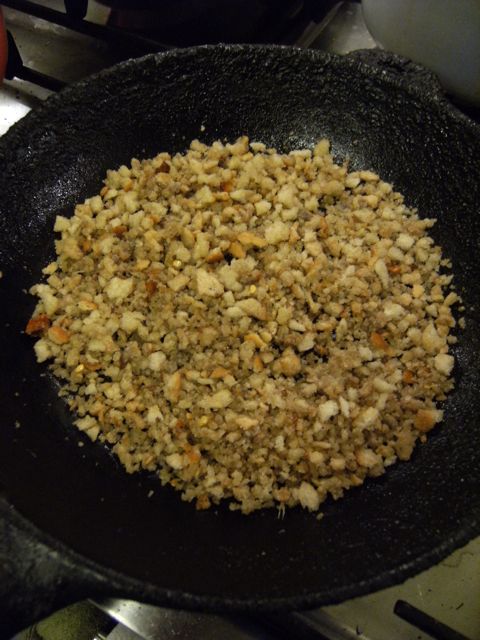
I also loved the sound of the ‘pangrattata’ bit – the anchovy & chilli breadcrumbs, giving crunch and added spiky flavour to a dish that otherwise might risk being bland.  And even though I fried it a bit beyond the ideal golden brown to something more like burnt umber on account of leaving the pan over a low flame when I thought I’d turned it off, this proved to be no disappointment, and is something I’ll definitely be adopting as a regular user up of slightly stale bread from now on.

I followed the recipe pretty much as written, using my own technique for the basic risotto (‘risotto bianco’) which, of course, skips the parmesan, although I did add a crushed clove of garlic to the breadcrumb mix, because why wouldn’t you?  It was thoroughly delicious, and as comfort food goes, I’d suggest it was potentially somewhere right up there with cauliflower cheese.  And that is really saying something.


Wednesday, 4 January 2012

Cauliflower Every Day 1: Cauli curry


So, farewell then 2011, hello and welcome 2012, and a happy new year to all my readers.  Many of you, I’m sure, will be feeling somewhat meated out – as is traditional at this time of year.  Some of you may even have made resolutions to eat less meat this month, this year, or for ever more.  Or even none at all.  For you then, and following on from the meat free comfort food theme of my last post of last year, I thought it was time to write up one of my favourite veggie meals – the cauliflower curry, a picture of which I’d used to illustrate my post written back in September in response to Hugh Fearnley Whittingstall’s book/TV/Guardian column exhortations to eat Veg Every Day.  I won’t re-cover that ground other than to endorse again his broad principle while retaining the reservations I expressed at the time.  I will add one thing: I thought then, and still do, that “Veg Every Day” is a duff title.  Surely most of us – even the most carnivorous of most us – would generally manage to consume some vegetable item every day anyway, even without giving it much thought.  Anyone who generally didn’t, would be considered something of a freaky eater, surely?

Anyway, cauliflower.  I love cauliflower, but because the default setting for me, as I suspect for most of us, when it comes to cauliflower remains cauliflower cheese – for me, not only one of the most comforting of all comfort foods, but the most evocative of specifically maternal comfort - I seldom pick one up.  I should more often, and not only to appease Hugh Fearnley Whittingstall (I have to admit, much as I love it, if I ate cauliflower every day I think its appeal would soon wane), but because to smother a cauliflower in cheese sauce is far from the most interesting thing you can do with it.  Although it does remain almost certainly the most comforting – as long as you’re not allergic to dairy products, of course.  

The cauliflower has a particular affinity for Middle Eastern and South Asian spices, and also, peculiarly, for being dyed bright yellow – as in piccalilli.  My cauliflower curry recipe fully exploits both affinities, although if you don’t like the flavour of turmeric, or simply don’t have any in your spice cupboard right now, you can serve it up au naturel.  I do think, however, that as pretty as raw cauliflower is, once cooked it can look kind of anaemic without any colour enhancement at all*.


Cauliflower Curry:

Garam masala 
Turmeric 
Garlic, finely sliced
Red chilli, finely sliced
Ginger, finely chopped
Cauliflower head, broken into large florets
Red onion
Leek (or fennel) - Optional
Mushrooms
Stock

Start your curry by making up your own spice mix.  You can call it that, or by all means call it home made garam masala – which is, I believe essentially the same phrase in Hindi.  Precisely what goes into a garam masala is entirely up to you and the contents of your spice cupboard, as it is a generic term with no single definitive recipe.  Or rather, more likely, as many single definitive recipes as there are grandmothers in the Indian sub-continent.  Which is a lot.  In my case, on this occasion, it contained black peppercorns, coriander, fennel, nigella and mustard seeds, toasted in the pan and pounded into a powder with the pestle and mortar along with a little hot paprika and cinnamon bark.  It really should, of course, contain cumin, if nothing else, but if, as I did on this occasion, you suddenly realize afterwards that you forgot to add any, don’t panic, just add whole cumin seeds when you come to cook your curry anyway, that’s good too.  In fact, even if you hadn’t forgotten to include cumin in your garam, you might like to throw in a sprinkling of whole seeds anyway for aesthetic and textural interest, maybe some fennel seeds too.

If you’re a perfectionist you will probably want to follow the standard advice when it comes to toasting the seeds for your spice mix, and do each component spice separately in the pan, one at a time on account of them taking different times to toast.  I am not a perfectionist and add them all to the pan together, but staggered in order of size, largest first, leaving a few seconds of toasting time for each before adding the next smallest item – quite how many seconds depending on the discrepancy in size.  This method, obviously, relies on guesswork but it seems to work.


Once you have your spices toasted and powdered, you’re ready to make your curry.  Heat the pan (toasting the forgotten cumin seeds in it as it heats, if you need to) then add a little oil, some chopped garlic, ginger and sliced red chillies.  Allow those flavours to infuse the oil for a few seconds before adding thickly sliced red onion (on this occasion in fact I had half a red onion and half a leek in the fridge, so I used onion and leek, as you might have noticed from the pictures, but just onion is fine, or you might also add fennel to the mix if you had some of that lying around) and a teaspoonful each of your own spice mix and turmeric.  Stir thoroughly to coat the onion in the spices and cook for a few minutes till starting to soften, then add the cauliflower.  Again, cook for a few minutes before adding mushrooms, and just a minute or so more before adding a cup of stock (I used Marigold instant on this occasion, but obviously if you have any homemade chicken, pheasant or other light stock to hand use that).  Cover the pan and allow to simmer away, for just 10 – 15 minutes – handily, just about as long as it takes you to cook your rice.


A variation on this recipe, and the one featured in the pictures below, another picture of which that I used to illustrate the HFW post, would be the addition of potatoes.  The method used there would be to cook up some new potatoes in your stock till almost done, and then add them, along with the stock at the same point you add just the stock in the recipe above.  In both variations, finishing the dish with a handful of coriander leaves and stalks, roughly torn from the bunch is good, as long as you like coriander.  Which I know not everyone does.


* I feel the need to point out here that this endorsement of colouring cauliflower does NOT, in any way, extend to that other frequently dyed bright yellow commodity, smoked haddock.  I love smoked haddock.  I despise chrome yellow smoked haddock.  It is an abomination.


Wednesday, 21 December 2011

One pot pollack steaks and rice: Meat free comfort food. Cheap, lazy and a little bit paella-ish


This time of year, with the nights drawing in some time around early afternoon, both the present and the future looking inescapably bleak, and the ghost of Christmas imminent haunting every waking (and sleeping) hour, it’s very easy to resort to meaty comfort foods for every meal - big hearty stews, shepherd’s pies, sausage casseroles and pot roasts.  And why not?  Comfort food’s called comfort food for a reason, and we all need a bit of that on these cold dark evenings.  But, as Hugh Fearnley Whittingstall has been seeking to prove recently, comfort doesn’t necessarily have to be meaty.  He’s right, of course, as I’ve said before, and as his River Cottage sidekick, and my own former colleague, Tim Maddams, reminded me in a recent Facebook message, reflexively falling back on meat is a lazy option for anyone who considers themselves in any way an adventurous cook.  Still, as anyone who’s familiar with this blog (or even just glanced through its archive) will know, we do find big lumps of meat particular comforting in our house.

Still. To meet HFW and Tim half way, here’s a very quick, easy, cheap, convenient and thoroughly comforting dish for a cold, dark evening, made entirely without meat, even if it does feature big meaty fish steaks.  And even if was conceived almost entirely out of laziness on my part.

I’d originally been thinking of making a fish stew, but my girlfriend of the time (this was many years ago) cancelled our dinner date.  Which was probably just as well as I’d left it late getting to the fishmonger’s stall on Brixton market, and the two Pollack steaks I’d been able to pick up there weren’t, on their own, going to make for a very interesting stew.   Cooking just for myself, as it turned out, I couldn’t have been bothered with anything as elaborate as a bouillabaisse anyway (not that a fish stew need be elaborate to be good), and decided I’d just simply cook the fish, and serve it with rice – probably, although I don’t recall this as a specific detail, simply to save myself the effort of peeling spuds. 

As I had a fish stock I’d made earlier, in preparation for the stew, already in my fridge, it was hardly a leap of creative genius to think of cooking the rice in fish stock rather than water, for added flavour, and then it was purely a matter of saving myself washing up to think why not cook the fish steaks in the same pan?  Why not indeed.  So I simply placed them on top of the rice and stock as it simmered away.  Other than that, all I did was add a dash of turmeric to the rice and stock, for a bit of colour.  And it turned out memorably good.


I’ve since developed the idea (if idea’s not too grand a word) into something that a bit more closely resembles a kind of quick and easy paella by simply slicing some red onion, red pepper and/or fennel and frying that in the pan in a generous slug of olive oil with a grind of black pepper and a pinch of salt, till it’s just starting to soften before sprinkling over a teaspoon of turmeric and stirring thoroughly to get a good even coating of the bright yellow spice (by all means use saffron instead if you want to go for something more paella like, but I like to keep this non fancy, and cheap).  Then I add the rice, and throw in half a glass of vermouth (if you have it, white wine if not, or even a sherry, but only the palest, driest fino, or, ideally manzanilla) and stir the rice and veg until the liquid’s been absorbed or evaporated, before pouring in the stock (add the stock hot, this does mean an extra pan to wash, but do that immediately and it really will need little more than rinsing out).  Just add all – or at least most, see below - the stock in one go, as if boiling the rice in water, or making a paella, rather than adding a ladleful at a time and constantly stirring, as for risotto – this will work even if using risotto rice.  I give it one good stir, then cover and leave it simmering gently for at least ten minutes before lifting the lid again to add the fish.

Exact timings will vary depending on the quantities you’re using and the type of rice.  Basmati, which is what I first used will cook through quicker than paella or any of the various types of risotto rice, but will take a little longer than it would were you simply boiling it in water, as you’ll want to be cooking it at a rather lower simmer.  For basmati, add the fish at ten minutes and check the rice as you do so.  You may need to add more liquid at this point (you can hold back a little of the hot stock for this, or simply use water from the kettle) if it’s all been absorbed – you want to see a little residual liquid above the surface of the rice, and copious steam.  Put the lid back on.


Again, times for cooking the fish will vary depending on how thick the steaks are cut.  But it really shouldn’t take much over five or six minutes, seven if the steaks are particularly thick, or the controls on your stove are fine enough to achieve a particularly gentle simmer.  Perhaps as much as eight in the case of both.  I would turn the steaks after three to four minutes, taking the opportunity to check the rice again.  Again, if need be, you can add more liquid, or just re-cover the pan and leave cooking for another two to three minutes.  Or, if the rice is, or very nearly is, done to your satisfaction at this point, just turn off the heat and let the residual heat and steam finish off the cooking of both fish and rice.  This should take no more than another five minutes. 

If you’re using paella or risotto rice, which take longer to cook just leave it longer, say 15 to twenty minutes before adding the fish.  The only trick to cooking this dish is gauging the right moment, about 5 to 7 minutes before the rice will be cooked to perfection, to add your fish.  But don’t worry, it doesn’t have to be exact – the fish will be cooked gently in a moist environment, so you don’t need to worry too much about overcooking or drying out, and you can always take out your fish when it’s done and keep the rice on the heat a few extra minutes at the end to finish it off.  


Monday, 12 December 2011

This is insane. Or just plain dishonest.


I was in Sainsburys the other day and saw this:


Yes that’s a bottle of wine, a red from Cahors.  Buy one of them, it’ll cost you £11.99.  Buy two and that’ll be a round tenner.  As in two quid cheaper for two than one on it’s own would be.  Who’s going to be fooled by that?  Who will really believe they are getting wine genuinely worth twenty four quid in return for just ten?  Surely even in a world in which people have become blandly accustomed to supermarket BOGOF promotions, the notion that Sainsburys are going to not just give you one item free when you buy one at full price, but will actually charge you less for the one you do pay for, presumably, for doing them the favour of taking another one off their hands, is absurd.  I mean, come on Mr Sainsbury, what’s wrong with this wine that you want rid of it so badly?

Clearly the stated full price is, at best, notional.  At worst it’s flat out dishonest.  And I’m afraid I have to go with worst in this case.  And it is indeed the worst kind of dishonesty – in the sense of ‘worst’ being the most rubbish.  Dishonesty so cack handedly blatant that the only people who could possibly be fooled are those not paying attention.  It’s the people doing their shopping distractedly – maybe people yakking on their mobile phones, but also perhaps young mothers with kids in tow - whose eyes take in the fact that this wine is on special offer without actually reading the details and pick up a single bottle, not noticing the extortionate price they’ve been charged for it until they get home that I feel sorry for.   The mothers at least, the mobile phone yakkers not so much…

Them and, indeed, the wine producers, who are almost certainly getting thoroughly screwed over by Sainsburys on cost to allow them the margin to dick about so comprehensively with the retail price.  Obviously I don’t know the details of the specific bit of business behind this particular deal, but have no doubt that it will be based on them producing twice the wine at half the price, which is bad for the wine makers, and ultimately bad for us – assuming we actually like and appreciate wine - because the wine simply will not, can not, be the best that they could make it in those circumstances.   I may not know much about making wine, but I do know that doubling volume, while cutting production costs is not the way to improve your product.  And, if we like and appreciate wine, why should we want the people who make it to gain neither profit nor satisfaction from doing so?  It seems to me we should want to encourage wine makers to make the best wine they can, not discourage them from making wine at all.

The one bunch of people you can be sure that this apparent largesse on Sainsburys part will turn out not to be bad for, will be Sainsburys themselves.  They, after all, choose the price.  Nobody is forcing them to give away a second bottle of wine at a negative price.  Which of course they’re not anyway.  The ‘real’ price of this wine will undoubtedly be closer to the £5 a bottle that two bottles works out at than that plainly spurious £11.99.  My guess would be that at £5 a pop it will probably turn out to be excellent value, indeed I’d think it most likely that this would turn out to be something you’d think was pretty good for six quid, OK but unremarkable at seven.  That is, as I say, just a guess, but I’d be amazed if it proved far wrong.  So you might well argue that two for a tenner is a bargain, and that’s good for us, the wine buying public. 

Well, yes, but also no.  Why not just price the wine honestly, Mr Sainsbury?  Don’t try and fool us into believing we’re getting a better deal than we are, and let us decide how many bottles we wish to buy.   And do you always have to push the wine makers into producing the volume to allow you to sell twice as many bottles at a lower price, rather than allowing them to produce a lower volume of a better, more interesting wine that we’d be happy to buy less of but at a higher price?*

I should of course, at this point, declare an interest.  My day job is in the wine trade, working for, if not strictly speaking a small, local independent wine shop, then an independent chain of shops that is much smaller and altogether more localized than it was at this time last year – circumstances for which I do not, incidentally, hold the supermarkets solely and entirely to blame.  I normally refrain from writing about wine on this blog, partly because of the obvious potential conflict of interests, and for the sake of my own independence, but also, and mainly, because it’s hard enough finding time and space to get down all that I have to say about the food, without getting started on the wine.  But this post really isn’t about wine, it’s about supermarket pricing policies – and the example here is Sainsburys, but this is not just about them, either - and what this example of a bottle (or two) of wine reveals about them.  Because if we recognize the inherent dishonesty in the pricing of this one item, why should we presume that everything else in the store is honestly and fairly priced?  Maybe (and that’s a heavily ironic ‘maybe’) we shouldn’t.


* Actually, to be fair to Mr Sainsbury, the answer to that second question is basically ‘yes’.  That’s just the way supermarket scale economics works, and why you’ll always be able to find more interesting wines in small independent wine merchants.  The more interesting and unusual wines, almost by definition  come from small producers with limited production, and they simply cannot supply in the kinds of volume that the supermarkets require to stock their many thousands of miles of collective shelf space.

Hello Denmark!

I've been translated into Danish!

http://translate.google.dk/translate?hl=da&langpair=en%7Cda&u=http://sebastianroach.blogspot.com/p/test-page.html

I know in these days of Babel Fish and Google translate this is no big deal (and probably makes very little sense), but still.  It's nice.

Tak Danmark!

Friday, 9 December 2011

Remember membrillo?


 No sooner, it seems, do I write about the long awaited arrival of Autumn, than Christmas lumbers into view.  Now I know this is as much to do with my recent slackness in updating this blog as it is to do with the late onset of Autumn, and nothing whatsoever to do with the early arrival of Christmas, which only appears to come round quicker every year, but still…  Anyway, if you’re here looking for Christmas ideas, then I’ll refer you to my post last Christmas posts from January , right now I still have autumn to get out of the way.  As, incidentally, does the weather – for all that as I write, Scotland is to all intents and purposes being blown away (a scenario that will doubtless please many, on both sides of Hadrian’s Wall) by the fiercest winds this century – so fierce they have their own Wikipedia entry.  Already!  Making ‘Bawbag’ official.  Kind of -  down here in the South, although it is admittedly a bit blowy right now, we are still in the throes of what is technically a drought.  It really has hardly rained at all this autumn.  And we’ve had three, maybe four days you could properly call chilly.  And we’re almost a third of the way through December!  At the risk of banging on, that’s not right is it?  SOMETHING MUST BE DONE.


Anyway, back to food.  Quinces.  Remember?  I’d made jelly, and was about to make membrillo.  It went like this.  Again, I simply followed that recipe and it came out fine, so I have little to add in terms of advice, other than do it: both the jelly and the membrillo (or quince cheese, if you must).  It really is so easy, and so very tasty.  The one comment I would make is that living as I do (and wouldn’t change for the world) with someone who can’t eat cheese, the opportunities for the consumption of membrillo might appear limited, but that just means it lasts longer.  I made my slab over three weeks ago now and took half of it, along with a big wedge of manchego to a dinner party hosted by our good friends Edgar and Lindsay.  A large part of the rest remains in our fridge, wrapped in greaseproof paper and sealed in a Tupperware container and will keep there perfectly happily for months, or even up to a year, I’m told, not that it stands even the slightest chance of remaining undevoured that long.  I would observe that as it matures, the flavour develops an increasingly strong hint of banana, but that’s the only difference I’ve noticed so far.  And I have no problem with banana.


Although membrillo is naturally and traditionally paired with manchego, what with being Spanish and all, it is worth bearing in mind that manchego is not the only cheese.  Not even in Spain.  I have found that it pairs particularly well with a nice crumbly Lancashire cheese (which pretty much by definition means it will go equally well with Caerphilly, Wensleydale and any other mildish, crumbly white cheese).  And the jelly too.  And of course you don’t need cheese at all, both the membrillo and the jelly will sit very happily on a plate with cold meats, pates or a good old pork pie. 


Ah.  Pork pie.  One of those combinations of words I cannot write, say, or even think without my mouth starting to water just a little bit.  I have long intended to get round to making one of my own, so much so that it’s an annual event, an essential part, indeed, of my own personal advent calender to wake up one day and realize that I’m not going to have time to make one for this Christmas either, again.  We are now rapidly approaching that day for this year.  Damn it.